Consult

2 min read
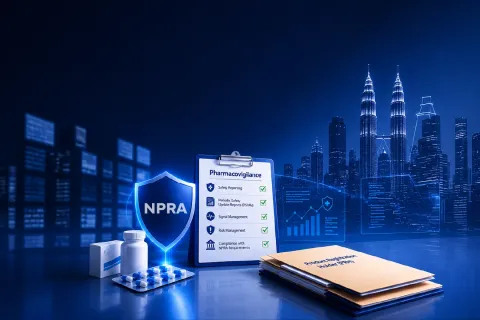
When it comes to drug registration Malaysia, the National Pharmaceutical Regulatory Agency (NPRA) plays a central role in screening, evaluating, and approving dossiers before products reach the market. A well-prepared, compliant submission not only accelerates approval timelines but also minimizes the risk of queries, delays, or rejections.
This guide outlines six essential steps to help pharmaceutical companies prepare a compliant NPRA drug submission Malaysia dossier and navigate the registration process effectively.
1. Understand NPRA Guidelines and Requirements
Before initiating dossier preparation, it is crucial to review the latest NPRA guidelines, particularly the Drug Registration Guidance Document (DRGD). This document outlines the administrative, technical, and scientific requirements for product registration. Adhering to the Malaysia regulatory guidance DRGD ensures that the submission meets current standards and avoids unnecessary back-and-forth with the agency.
2. Drug Registration Malaysia: Structure the Dossier in ACTD Format
Malaysia adheres to the ASEAN Common Technical Dossier (ACTD) format, consisting of four main parts:
- Part I: Administrative and Product Information
- Part II: Quality Document
- Part III: Non-clinical Document
- Part IV: Clinical Document
Following the ACTD Malaysia drug registration framework ensures consistency, clarity, and compliance across all submitted dossiers.
3. Conduct a Gap Analysis
A gap analysis helps identify missing or non-compliant data early. By addressing deficiencies before submission, companies can avoid NPRA queries that delay approvals.
4. Ensure GMP Compliance
Manufacturing sites involved in the product lifecycle must comply with NPRA GMP Malaysia requirements. They must hold GMP certification recognized by NPRA.
The GMP should be incompliance with the current PIC/S guide to GMP for Medicinal Products and its Annexes used by NPRA to assess the GMP conformity of manufacturers. For overseas facilities, NPRA may request on-site GMP inspections.
5. Compile and Validate Modules
When compiling the dossier, best practices include:
Using NPRA checklists for dossier completeness
Ensuring product labeling and packaging meet NPRA standards
Validating electronic submission formats (via Quest3+ system)
6. Submit and Maintain Communication with NPRA
Dossiers are submitted through the Quest3+ NPRA Malaysia, the agency’s electronic submission platform. Maintaining proactive communication with NPRA officials and responding promptly to queries ensures smoother approvals.
Freyr’s Case Study: Supporting a USA-Based Leading Company in Malaysia
Client Overview:
A leading USA-based company engaged Freyr to support their pharmaceutical regulatory submissions in Malaysia.
Project Details:
Freyr’s engagement included the following activities:
Preparation of the dossier
Review of dossier (Gap analysis) as per country-specific regulatory requirements
Compilation of modules according to Malaysia’s regulatory standards
Submission of company registration dossier & product registration dossier, with periodic follow-up with country-specific regulatory authorities until product approval
Outcome:
With Freyr’s support, the client successfully completed the registration process in Malaysia. The timely preparation, review, and follow-up ensured smooth approval of the products and compliance with local regulatory requirements.
Summary:
Step | Title | Key Focus |
1 | Understand NPRA Requirements | Review DRGD, product classification, and regulatory updates |
2 | Structure in ACTD Format | Organize dossier into four ACTD parts |
3 | Conduct Gap Analysis | Identify and address missing/non-compliant data before submission |
4 | Ensure GMP Compliance | Secure NPRA-recognized GMP certification for all manufacturing sites |
5 | Compile and Validate Modules | Use checklists, verify labeling, validate e-submission formats |
6 | Submit & Communicate with NPRA | Submit via Quest3+, maintain proactive communication to expedite approvals |
Conclusion
Preparing a compliant NPRA dossier requires precision, regulatory knowledge, and seamless execution across multiple steps. From ACTD formatting to GMP compliance and proactive communication with NPRA, every stage impact approval timeline and market success.
Freyr, with its deep regulatory expertise and proven track record across ASEAN markets, empowers pharmaceutical companies to streamline NPRA submissions, minimize risks, and achieve faster product approvals in Malaysia. By combining local insights with global experience, Freyr transforms regulatory challenges into opportunities for sustained growth.