Consult


2 min read
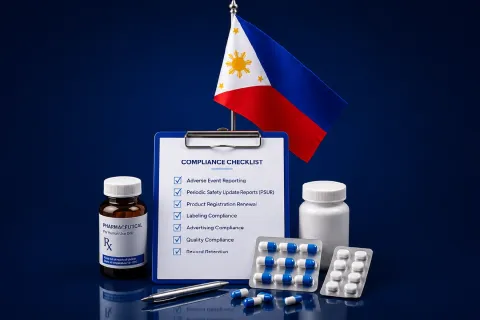
The drug registration Philippines pathway is an increasingly important process in Southeast Asia’s pharmaceutical landscape, offering access to a growing patient population and a dynamic regulatory environment.
The process is overseen by the Food and Drug Administration (FDA Philippines) under the Department of Health (DOH), ensuring that all pharmaceutical products entering the market meet standards of safety, efficacy, and quality. With structured procedures and adherence to Philippines pharmaceutical regulations, companies can ensure smooth entry into this expanding market.
Drug Registration Philippines: Step-by-Step Regulatory Pathway
- Pre-Submission Preparation
- Application Submission via eServices Portal
- Screening
- Technical Evaluation
- Registration Approval and CPR Issuance
- Import License Requirements
- Pharmacovigilance System Setup
- Local Labeling and Packaging Compliance
- Post-Approval Variations
- Renewal and Post-Market Surveillance
1. Pre-Submission Preparation
Pharmaceutical companies must classify their products correctly (prescription, OTC, biologic, vaccine, etc.) and determine the applicable registration requirements. The Marketing Authorization Holder (MAH) must be a Philippine-registered company.
2. Application Submission via eServices Portal
Applications are submitted online through the FDA’s eServices Portal, following the ASEAN Common Technical Dossier (ACTD) or ASEAN Common Technical Requirements (ACTR). Key documents include:
- Product formulation and specifications
- GMP certificates of the manufacturing site
- Certificate of Pharmaceutical Product (CPP) from the country of origin
- Proposed labeling and packaging
3. Screening
The FDA Philippines screens the dossier for completeness and format compliance. Incomplete submissions are returned and must be resubmitted, delaying the evaluation process.
4. Technical Evaluation
The FDA conducts a scientific review of quality, safety, and efficacy data. For new drugs, evidence from clinical trials or recognized reference agencies may be required. Generics undergo bioequivalence testing as part of the assessment, ensuring compliance with FDA Philippines drug approval standards.
5. Registration Approval and CPR Issuance
Upon successful evaluation, the FDA issues a Certificate of Product Registration (CPR). This serves as the legal authorization to import, distribute, and market the product in the Philippines.
6. Import License Requirements
An Import Permit is mandatory for all registered products manufactured overseas. Local companies must secure this from the FDA to ensure legitimate entry into the country.
7. Pharmacovigilance System Setup
Companies must establish a pharmacovigilance (PV) system for monitoring product safety post-launch. Serious Adverse Drug Reactions (ADRs) must be reported promptly to the Pharmacovigilance Philippines FDA unit.
8. Local Labeling and Packaging Compliance
Labeling must follow FDA standards, including:
- English and/or Filipino language
- Clear dosage, usage instructions, and safety warnings
- Marketing claims strictly limited to approved indications
9. Post-Approval Variations
Any changes to registered products—formulation, packaging, manufacturing site, or labeling—require variation applications. FDA approval must be obtained before implementing these changes.
10. Renewal and Post-Market Surveillance
Certificates of Product Registration (CPRs) are valid for 5 years. Renewals must be filed at least 90 days before expiration. Companies must also comply with ongoing post-market surveillance activities, such as ADR reporting and GMP inspections.
Summary Table
Step | Title | Summary |
| 1 | Pre-Submission Preparation | Determine classification and appoint a local MAH |
| 2 | Application Submission | File via eServices portal in ACTD/ACTR format |
| 3 | Screening | FDA checks dossier completeness |
| 4 | Technical Evaluation | FDA reviews safety, efficacy, and quality |
| 5 | Registration & CPR | Issuance of Certificate of Product Registration |
| 6 | Import License | Mandatory for overseas-manufactured products |
| 7 | Pharmacovigilance | ADR reporting and safety monitoring required |
| 8 | Labeling Compliance | Labels must meet FDA requirements |
| 9 | Variation Applications | Changes must be submitted and approved |
| 10 | Renewal & Surveillance | CPR valid for 5 years; renewal and PMS required |
Conclusion
The drug registration Philippines pathway is structured, multi-step, and compliance focused. From ACTD submissions and GMP documentation to pharmacovigilance and post-market surveillance, each step requires accuracy and timely execution.
To streamline submissions, ensure FDA Philippines drug approval compliance, and reduce regulatory risks, partnering with an experienced regulatory partner like Freyr can help pharmaceutical companies navigate Philippines pharmaceutical regulations confidently and efficiently.