Consult


2 min read
Understanding how to register a pharmaceutical product in the Philippines is essential for companies aiming to launch safe and effective medicines in the market. The process is regulated by the Food and Drug Administration (FDA) Philippines, ensuring that every approved product meets the highest Regulatory compliance and quality standards.
The FDA has established structured Regulatory requirements for product registration, evaluation, and post-marketing monitoring. Below are the 10 most frequently asked questions to help you navigate the drug approval process effectively.
Pharmaceutical Product Registration: Key FAQs
1. Who can register a drug product with FDA Philippines?
Only establishments holding a valid License to Operate (LTO) from the FDA can register a pharmaceutical product for sale in the country.
2. What is the general procedure for drug registration?
Applications are submitted electronically through the FDA e-service portal. The dossier must follow the ASEAN Common Technical Dossier (ACTD) format and meet all Regulatory requirements.
3. Which documents are required for initial registration?
Core documents include the application form, LTO, technical dossier, proof of payment, Good Manufacturing Practice (GMP) certificate, and validated labeling. For biologics, additional data such as safety and stability studies are mandatory.
4. What are the standard timelines for drug registration?
- Abridged Review: Up to 45 working days
- Verification Review: Up to 30 working days (for products with prior RDRA approval)
Note: Standard timelines apply for new products without prior reference approvals.
5. What are the labeling requirements?
Labels must follow FDA guidelines, include product information and warnings in English or Filipino, and in some cases, require patient information leaflets in local dialects.
6. Why is GMP certification important?
A valid GMP certificate is essential to prove manufacturing quality and maintain Regulatory compliance. It is required during both initial registration and renewal stages.
7. What are post-approval requirements?
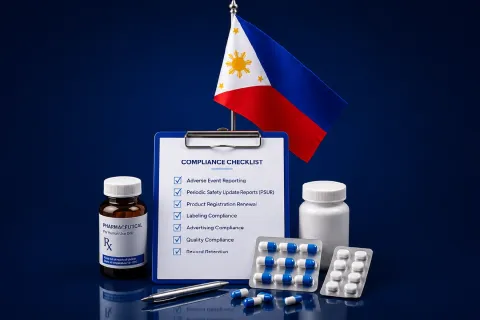
Holders of marketing authorization must maintain Regulatory compliance through post-marketing surveillance, reporting of adverse events, recalls, and submission of periodic safety updates.
8. How are variations and renewals managed?
Changes in the product (formulation, manufacturing site, etc.) require notification or a new application, while renewals must follow specific schedules and include all required documentation.
9. Does FDA approval of a brand name grant intellectual property rights?
No. FDA approval only confirms Regulatory acceptability. Intellectual property rights are managed separately by the Intellectual Property Office of the Philippines (IPOPHL).
10. How does FDA assess benefit-risk for new drugs under local conditions?
The Philippine FDA evaluates every drug application not only for compliance with technical and documentary requirements, but also for the suitability of use under local conditions. This involves a benefit-risk assessment in the Philippine context—considering local disease patterns, patient needs, and supporting data such as stability studies, clinical trials, and risk management plans.
The FDA may engage external experts as needed to guide its evaluation. This ensures that only drugs proven safe, effective, and of high quality for the Filipino population receive authorization for marketing.
Conclusion: Ensuring Regulatory Compliance for Pharmaceutical Product Approval
Successfully navigating the drug approval process in the Philippines requires attention to detail, robust documentation, and strong understanding of Regulatory compliance standards. Each step—from dossier preparation to post-marketing activities—must align with FDA Regulatory requirements.
Collaborating with Freyr ensures your pharmaceutical product submissions meet every expectation for safety, quality, and compliance, accelerating your pathway to market success.