Consult


3 min read
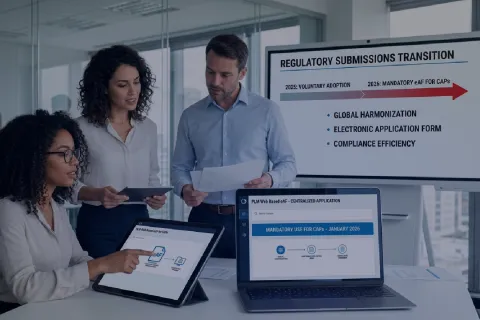
As global health authorities accelerate digital transformation, regulatory submissions are no longer evaluated solely on scientific merit. Structure, data integrity, metadata quality, and process maturity now determine whether a dossier is accepted, delayed, or rejected at the gate.
By 2026, regulators such as FDA, EMA, PMDA, and other regional authorities will expect submission-ready dossiers—not just compliant documents, but end-to-end, inspection-ready regulatory packages built on standardized processes and validated data.
At Freyr, years of supporting global submissions across regions have led to the development of a 2026 Compliance Framework—a process-driven model that helps sponsors build dossiers that are not only compliant, but submission-ready from day one.
This article outlines that framework and explains how regulatory teams can operationalize it.
What Does “Submission-Ready” Really Mean in 2026?
Traditionally, regulatory readiness was assessed late in the lifecycle—often during publishing or just before submission. In 2026, that mindset is no longer sustainable.
A submission-ready dossier is one that:
- Aligns with current and upcoming regulatory mandates
- Uses approved data standards and controlled vocabularies
- Passes authority-specific technical validation on first pass
- Maintains lifecycle traceability and audit readiness
- Can be submitted across regions with minimal rework
In short, readiness is not an event—it is a continuous process.
The Problem with Fragmented Submission Models
Many organizations still operate with siloed regulatory workflows:
- Clinical data prepared independently of submission strategy
- Authoring completed without lifecycle considerations
- Publishing treated as a downstream formatting exercise
- Validation addressed only at the final stage
This fragmentation leads to:
- Last-minute remediation
- Repeated validation failures
- Region-specific rework
- Increased submission risk and cost
Freyr’s 2026 Compliance Framework was designed to eliminate these inefficiencies.
Freyr’s 2026 Compliance Framework: A Process-Driven Model
The framework is built on five interconnected pillars, ensuring that regulatory compliance is embedded from planning through submission and post-approval.
Pillar 1: Regulatory Intelligence-Led Planning
Submission readiness starts long before documents are authored.
Freyr’s framework embeds regulatory intelligence at the planning stage, ensuring alignment with:
- Upcoming authority mandates (eCTD v4.0, structured content, data standards)
- Region-specific requirements (Module 1 variations, local rules)
- Timelines for compliance enforcement
Key outcomes:
- Fewer mid-cycle surprises
- Proactive risk mitigation
- Region-specific strategies defined early
Best practice: Treat regulatory intelligence as a living input, not a one-time review.
Pillar 2: Data & Content Standardization by Design
In 2026, regulators expect consistency—not just within a submission, but across programs and regions.
This pillar focuses on:
- Alignment with authority-accepted data standards (e.g., CDISC versions)
- Standardized authoring templates and style guides
- Consistent terminology and controlled vocabularies
- Early linkage between datasets, summaries, and reports
Why it matters:
Inconsistent data and content are among the leading causes of regulatory queries and technical rejection.
Best practice: Build standardization upstream to avoid downstream remediation.
Pillar 3: Metadata & Lifecycle Governance
Modern submissions are driven as much by metadata as by documents.
Freyr’s framework emphasizes:
- Accurate document classification
- Lifecycle operators defined at creation
- Metadata QA as a governed activity
- Change impact analysis across sequences
This approach ensures:
- Clean lifecycle transitions
- Reduced reviewer confusion
- Strong inspection defensibility
Key insight: A dossier is only as strong as its metadata.
Pillar 4: Continuous Validation & Quality Control
Validation should not be a final checkpoint—it should be continuous.
Freyr’s compliance model integrates:
- Authority-specific validation rules (FDA, EMA, PMDA, etc.)
- Automated checks within publishing workflows
- Pre-submission technical dry-runs
- Documented validation evidence for audits
Benefits include:
- First-pass acceptance
- Fewer technical queries
- Predictable submission timelines
Best practice: Treat validation as a quality system, not a tool.
Pillar 5: Submission & Post-Approval Readiness
Submission readiness extends beyond the initial filing.
Freyr’s framework supports:
- Clear submission sequencing strategies
- Region-specific cover letters and messaging
- Post-approval change management
- Lifecycle maintenance and variation readiness
This ensures dossiers remain:
- Inspection-ready
- Update-friendly
- Aligned with evolving regulations
Result: Long-term compliance, not short-term success.
What Makes Freyr’s Framework Different?
Unlike generic compliance models, Freyr’s 2026 Compliance Framework is:
- Process-first, not tool-first
- Built on real submission experience across regions
- Scalable across products and portfolios
- Designed for evolving regulatory expectations
It bridges the gap between strategy, execution, and technology—the three areas where most submission failures originate.
Measuring Submission Readiness: Key Indicators
Organizations using a process-driven framework typically track:
- First-cycle technical acceptance rate
- Number of validation findings per submission
- Rework hours per sequence
- Time from final document lock to submission
- Inspection readiness metrics
These indicators shift regulatory operations from reactive to predictive.
Preparing for 2026: Where to Start
Immediate actions:
- Assess current submission processes against future mandates
- Identify data, metadata, and validation gaps
- Standardize templates and workflows
Mid-term actions:
- Integrate continuous validation
- Strengthen lifecycle governance
- Train cross-functional teams on submission readiness principles
Long-term actions:
- Embed compliance into development programs
- Align global and regional submission strategies
- Build inspection-ready regulatory systems
Final Thought: Compliance Is a Capability, Not a Deadline
As regulatory expectations evolve, organizations that succeed will be those that institutionalize compliance rather than chase mandates.
Freyr’s 2026 Compliance Framework is built on this philosophy—helping sponsors move from last-minute compliance to always-ready regulatory excellence.
Want to assess how submission-ready your dossiers are for 2026