Consult


3 min read
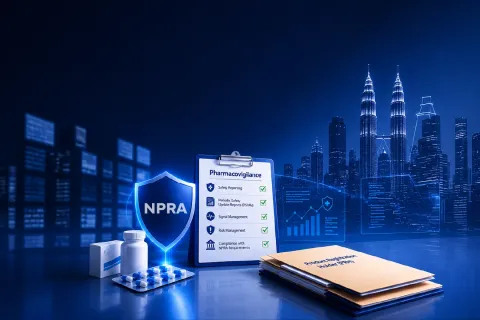
Manufacturers planning market entry must prepare for Malaysia pharmaceutical regulations 2026, as several Regulatory reforms effective from 2025 will directly impact approvals, compliance timelines, and post-market obligations. These Malaysia pharma Regulatory updates introduce stricter documentation standards, enhanced safety oversight, and expanded digital requirements under the National Pharmaceutical Regulatory Agency (NPRA).
Understanding these evolving NPRA Regulatory requirements early is essential to ensure smooth product approvals and sustained market access.
Key Regulatory Changes and Updates (2025–2026)
- 1. Drug Registration Guidance Document (DRGD) 3rd Edition, 10th Revision
- Effective 31 July 2025: All new product applications must comply with the NPRA DRGD 10th revision, which forms the backbone of Malaysia drug registration guidelines. This major update covers full administrative, technical, and safety data requirements for all product types (generics, innovator drugs, biologics, health supplements, and APIs).
- Timelines for product registration have been revised, including a 40-working-day abridged route for export-only products.
- Enhanced stability and quality documentation requirements.
- Reference: DRGD 10th Revision
These changes significantly affect companies planning pharmaceutical market entry Malaysia in 2026.
- 2. New Requirements for Drug Information Leaflet (RiMUP)
- Starting 1 April 2025, the Pharmaceutical Regulatory Agency requires the first version of the RiMUP (drug information leaflet) to be evaluated by its Pharmacovigilance section.
- Manufacturers must follow detailed format and content guidance as per the latest RiMUP guideline.
- Reference: RiMUP Guidelines
- 3. Electronic Labelling (E-Labelling) Expansion
- From August 2025, more categories of pharmaceutical products must implement e-labelling. Labels must include QR codes or digital links providing up-to-date product and patient information, supporting Regulatory compliance and traceability.
- Reference: E-Labelling Directive
- 4. Addendum to Good Pharmacovigilance Practices (GVP)
- October 2025: Enhanced pharmacovigilance requirements: greater detail in adverse drug reaction (ADR) reporting, periodic safety updates, and system audits for all registration holders.
- The GVP Addendum introduces mandatory submission of risk management plans for higher-risk or newly registered products, as well as stricter timelines for reporting both serious and non-serious ADRs.
- Registration holders must also demonstrate the capacity for real-time safety signal detection and implement training for staff involved in pharmacovigilance processes.
- Reference: GVP Addendum
- 5. Cell and Gene Therapy Product (CGTP) Regulation (2nd Edition)
- Effective September 2025: Clarifies Regulatory pathway, GMP, ethical requirements, and specific licensing for advanced therapy products (cell and gene therapies).
- The CGTP Guidelines introduce detailed submission formats for preclinical and clinical data, including safety, efficacy, and quality aspects tailored for novel therapies.
- There is now a clear requirement for ethical committee approval, ongoing patient registry tracking, and special post-marketing surveillance obligations unique to cell and gene therapy products.
- Reference: CGTP Guidelines
- 6. Farmatag® Safety Label :
- Effective 7 October 2025: Malaysia’s NPRA has introduced the Farmatag® safety label to strengthen pharmaceutical product authenticity, traceability, and patient safety, requiring registered products to adopt digital verification labels with a defined transition period.
- Read More: https://www.freyrsolutions.com/blog/the-farmatagr-safety-label-malaysia-update-whats-changing-and-why-it-matters-to-you
Core Regulatory Requirements for Pharmaceutical Market Entry
- Product Registration: All products for human use must be registered with the NPRA and comply with the latest DRGD.
- Legal Framework: Compliance is required under major acts, including the Sale of Drugs Act 1952, Poisons Act 1952, Dangerous Drugs Act 1952, and the Control of Drugs and Cosmetics Regulations 1984.
- GMP Compliance: Full adherence to (often audited) latest Good Manufacturing Practice (GMP) standards as per PIC/S GMP Guide is mandatory for both local and imported products.
- Comprehensive Dossiers: Administrative, technical, preclinical/clinical, bioequivalence, stability, and quality data in line with updated NPRA requirements.
- Local Representation: Overseas manufacturers MUST appoint a local Product Registration Holder (PRH) or registration holder.
Other Strategic and Operational Considerations
- Digital Submission Readiness: With e-labelling and digital document requirements expanding, digital readiness will aid efficiency and compliance.
- Pharmacovigilance Systems: Companies must maintain and document robust systems for monitoring and reporting safety and quality issues post-market.
- Supply Chain Management: With new shortage reporting guidelines, manufacturers must monitor, forecast, and transparently communicate supply risks.
- Market Access: Consider pricing transparency, formulary inclusion, and participation in procurement or drug-price monitoring programs.
- Clinical Trials: All clinical trials—including First-In-Human and innovative products—require specific licensing, ethical approval, and notification.
Summary
- Manufacturers entering Malaysia’s pharmaceutical sector in 2026 must comply with major Regulatory updates effective from 2025: notably, the new DRGD (10th revision), expanded e-labelling, stricter RiMUP, along with enhanced pharmacovigilance rules.
- Key legal frameworks (various acts and regulations) and NPRA technical guidelines underpin every registration.
- A local representative, GMP compliance, digital capability, and operational risk management are foundational requirements.
- Special rules apply to advanced therapies and clinical development involving human subjects.
Conclusion
Navigating Malaysia pharmaceutical regulations 2026 requires early planning, strong Regulatory intelligence, and precise execution across registration, safety, and post-market compliance. With multiple Malaysia pharma Regulatory updates reshaping approval pathways, manufacturers benefit from expert guidance to minimize risk and accelerate market access.
Freyr supports pharmaceutical companies with end-to-end NPRA Regulatory strategy, dossier preparation, compliance management, and post-approval support—ensuring confident, compliant, and timely entry into the Malaysian market.