Consult


3 min read
In the rapidly changing fields of pharmaceuticals and medical devices, ensuring a product's safety is crucial—not just for Regulatory approval but also for patient health. A key component of preclinical documentation is the Toxicological Risk Assessment (TRA). TRA involves scientifically assessing a substance’s possible harmful effects on human health using non-clinical datasets from animal studies or in vitro tests. It is a vital element of submission dossiers for both pharmaceuticals and medical devices.
TRA is essential for identifying, quantifying, and communicating risks before human exposure. It informs safe dose estimation and risk management, so non-clinical medical writers must present TRA data clearly and compliantly to meet global regulators.
Why is TRA Essential in Non-clinical Medical Writing?
Every Regulatory agency expects manufacturers to articulate a comprehensive risk-benefit profile for new drug products. According to the Common Technical Document (CTD) structure, non-clinical safety data—including toxicology, pharmacology, and pharmacokinetics—must be carefully compiled (see Directive 2001/83/EC, Article 1, and ICH M3(R2) guidance). The goal is to demonstrate, through rigorous non-clinical evaluation, that any risks are clearly identified, scientifically justified, and, where possible, mitigated.
In practical terms, TRA sections within non-clinical modules should address:
- Identified potential toxicities (acute, chronic, reproductive, etc.)
- Genotoxicity and carcinogenicity data
- Dose-relationship and margin of safety
- Special risks, such as impurities
- Justifications for omitted studies
This approach is echoed in Regulatory guides from authorities such as the European Medicines Agency (EMA), Health Canada, and the Therapeutic Goods Administration (TGA).
Key Elements & Stages of TRA
A foolproof TRA typically includes the following stages:
- 1. Hazard Identification: Reviewing all available data on the substance’s toxic potential, assessing endpoints like organ toxicity, mutagenicity, or sensitization.
- 2. Dose-Response Assessment: Establishing the relationship between dose and observed effects, including margin of exposure (MOE) calculations.
- 3. Exposure Assessment: Estimating potential human exposure under anticipated clinical use conditions.
- 4. Risk Characterization: Integrating the above to provide a risk estimate, addressing uncertainties, and proposing risk mitigation where needed.
For substances such as leachables and extractables in devices or genotoxic impurities in pharmaceuticals, focused risk assessments are essential. Updated guidelines, such as ICH M7(R1)/(R2), require an assessment and control strategy for mutagenic impurities.
Regulatory Requirements
TRA is often a mandatory element within registration dossiers:
- In the EU and Canada, non-clinical data is scrutinized for quality, completeness, and scientific validity.
- Environmental Risk Assessments (ERA) may be required for certain submissions, investigating drug persistence and bioaccumulation potential.
Agencies assess whether the non-clinical dossier supports an acceptable risk-benefit ratio for human exposure. They expect a clear rationale for the selection (or non-selection) of models and endpoints, application of the 3Rs principle in animal testing, and a thorough synthesis of risk in summary sections.
Best Practices for TRA Documentation
How a Regulatory Affairs Partner like Freyr Can Help
Navigating the complex, evolving landscape of global TRA requirements is challenging. This is where collaboration with an experienced Regulatory Affairs (RA) partner, such as Freyr, becomes invaluable.
Here’s how partnering with a Regulatory expert boosts TRA outcomes:
- TRA Expertise: Freyr’s professionals stay updated on the latest toxicological and Regulatory requirements, such as ICH M7(R2) or EMA’s evolving expectations.
- Gap Analysis: RA experts evaluate existing non-clinical data, pinpointing gaps relative to targeted market regulations to ensure there are no surprises at submission.
- Dossier Preparation and Review: Freyr prepares clear, compliant, and audit-ready TRA sections for CTDs or device technical files, supporting client teams from strategy to submission.
- Consultation & Liaison: They serve as a bridge for communication with Regulatory agencies, addressing questions and facilitating prompt, robust responses.
- Training and Process Optimization: A seasoned partner helps align your team’s medical writing processes to industry best practices, reducing rework and accelerating timelines.
Especially for organizations with global ambitions or limited internal resources, a partner like Freyr enables confident, efficient navigation of TRA documentation, removing barriers to successful global product registration.
Summary
- TRA is vital in non-clinical medical writing, underpinning product safety and Regulatory success for pharmaceuticals and medical devices.
- Proper TRA involves hazard identification, dose-response, exposure estimates, and risk characterization—each clearly documented for assessors and accessible to broader teams.
- Regulatory requirements (ICH, EMA, TGA, etc.) demand comprehensive, scientifically justified toxicological summaries within registration dossiers.
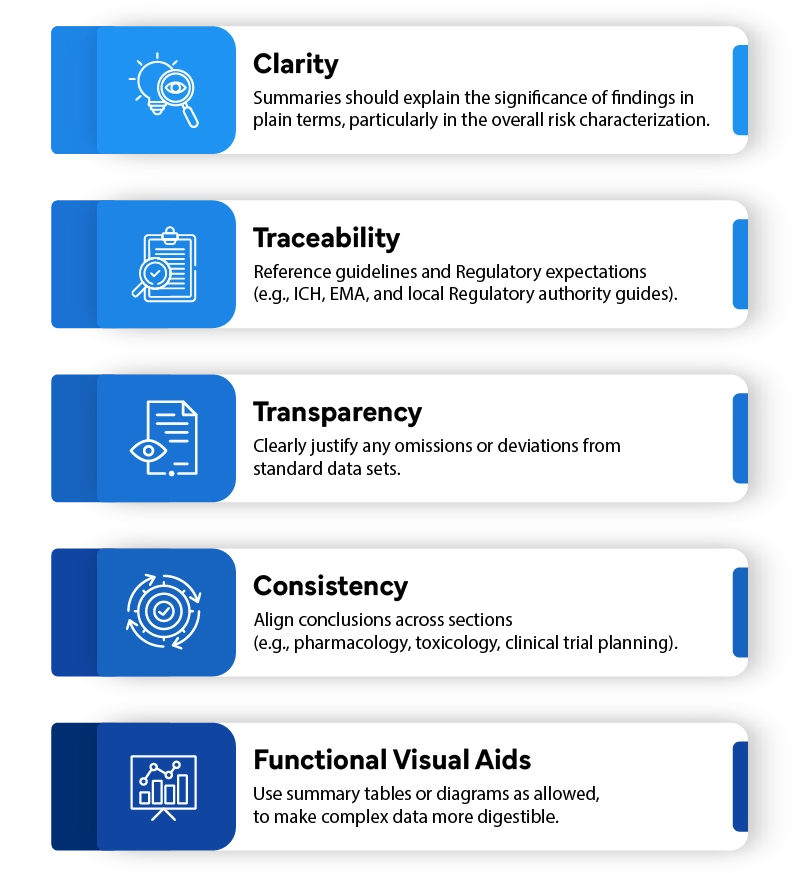
- Best practices include clarity, transparent data presentation, and consistent regulatory alignment.
- A Regulatory Affairs partner like Freyr delivers up-to-date expertise, detailed gap analysis, compliant documentation, and strategic guidance to optimize your TRA submissions and Regulatory outcomes.