Contact Us


Client Overview
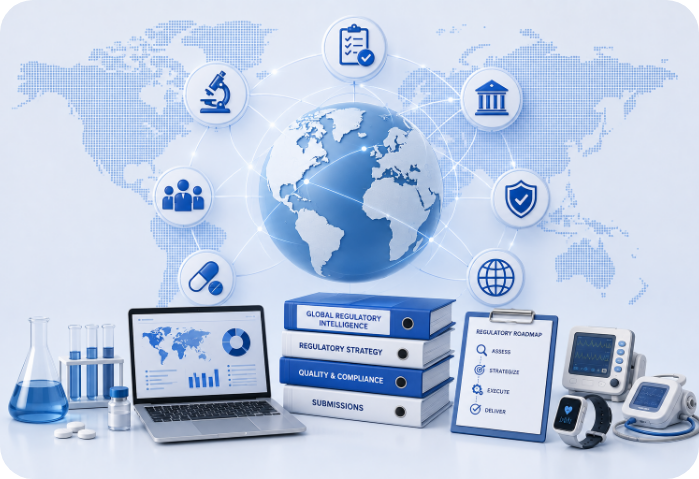
A global contract research and consulting organisation supports pharmaceutical, biotechnology, and medical device companies across multiple countries and regulatory jurisdictions.
As part of its consulting engagements, the organisation regularly monitors regulatory developments, interprets their relevance, assesses potential impact on client portfolios, and translates the findings into structured reports and recommended actions.
With clients operating across 30+ countries and spanning different product categories, regulatory functions, and risk profiles, the organisation required a scalable infrastructure that could support repeatable impact assessment workflows without compromising quality or consistency.

Background
Regulatory impact assessments formed a core part of the client’s consulting services. For every engagement, analysts needed to collect regulatory updates from multiple jurisdictions, classify them according to subject area and product type, determine their relevance, assess the potential business impact, and present the findings in a clear and defensible format.
However, much of this process depended on manual data collection, spreadsheet-based consolidation, and repeated formatting. The structure and format of regulatory updates also varied considerably across countries and health authorities.
As the number of clients and jurisdictions increased, the organisation needed a more structured way to manage regulatory intelligence, document assessment outcomes, and generate client-specific reports without proportionally increasing manual effort.

Services in Scope

Custom configuration of a Regulatory Analytics and Reporting Dashboard

Automated integration of global regulatory updates

Structured recording of regulatory impact assessments

Client-specific report generation and export

Historical tracking and reusable workflows across engagements

Support for consulting programmes spanning multiple countries and product types

Challenge
The client was conducting impact assessments for multiple organisations, each with different product portfolios, geographical footprints, and regulatory priorities.
Every assessment required analysts to gather and interpret updates from disparate regulatory sources. These updates varied by region, health authority, format, product type, and regulatory category, making it difficult to maintain a consistent assessment methodology.
As consulting volumes increased, these inefficiencies created several challenges:
Key Challenges

Regulatory information was distributed across multiple sources and formats.

Analysts spent considerable time collecting, consolidating, and formatting data.

Assessment methodologies and report structures could vary across engagements.

Manual handling increased the risk of omissions and data-entry errors.

Generating a consolidated client report could take approximately four to five days.

Scaling the service across additional countries and clients required corresponding increases in effort.
The organisation needed a repeatable and scalable workflow that could preserve analyst judgement while reducing the operational burden surrounding each impact assessment.

Solution
1

Customised Regulatory Analytics Dashboard
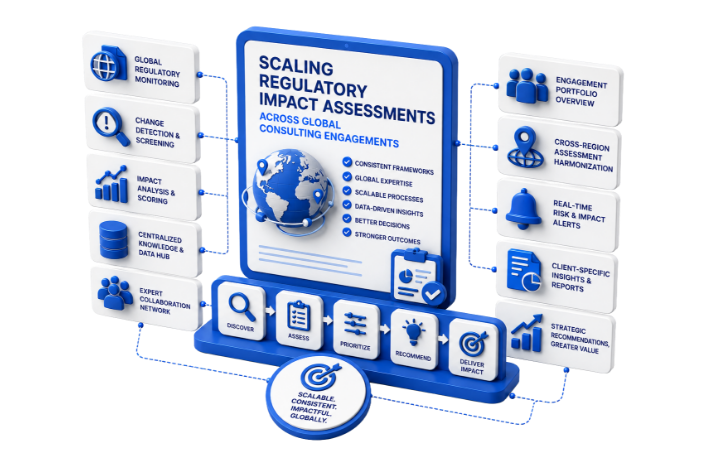
Freyr configured a tailored dashboard aligned with the client's consulting workflow, incorporating fields for region, regulatory agency, product type, regulatory category, client assignment, impact level, risk classification, and recommended actions.
2

Automated Regulatory Data Integration
Relevant health authority updates and regulatory changes from the global repository were automatically fed into the dashboard, reducing manual collection effort and ensuring timely access to current regulatory information.
3

Integrated Impact Assessment and Reporting Workflow
Analysts recorded client-specific evaluations within the Regulations module, with the findings flowing directly into the dashboard to connect monitoring, interpretation, impact assessment, risk categorisation, and action planning within one structured process.
4

Standardised Client Reporting and Reusable Delivery Model
A report-export capability generated consolidated, audit-ready client reports covering regulatory changes, assessments, risks, and recommended actions. Historical tracking and continuous updates enabled the same methodology to be reused consistently across clients, countries, and consulting engagements.

Impact

70% Faster Reporting
Client report generation time was reduced from approximately four to five days to less than 1.5 days.

90% Fewer Manual Errors
Automated regulatory updates and dashboard-based tracking significantly reduced errors and omissions.

100% Reporting Consistency
Standardised report structures improved clarity, comparability, and audit readiness across client engagements.

Coverage Across 30+ Countries
The dashboard was configured to support the organisation's global clients across more than 30 countries.

Scalable Consulting Delivery
The organisation expanded its impact assessment services across multiple geographies and clients without a corresponding increase in manual effort.

Greater Focus on Analysis
Regulatory teams spent less time on data collection and formatting, allowing them to concentrate on interpretation, impact evaluation, and strategic recommendations.