Consult

The U.S. Cosmetics industry is undergoing its most significant Regulatory transformation in decades with the implementation of the Modernization of Cosmetics Regulation Act of 2022 (MoCRA), commonly referred to as the MoCRA Regulation. As the first major update to U.S. Cosmetic Regulations since 1938, MoCRA Regulation introduces new obligations for cosmetic manufacturers, brand owners, importers, distributors, and facility operators marketing products in the United States.
To achieve and maintain MoCRA Compliance, companies must meet a range of requirements, including FDA Cosmetic Facility Registration, FDA Cosmetic Product Listing, safety substantiation, adverse event reporting, and Cosmetic labeling compliance.
What is MoCRA?
The Modernization of Cosmetics Regulation Act of 2022 (MoCRA), enacted as part of the Consolidated Appropriations Act, 2023, grants the U.S. Food and Drug Administration (FDA) expanded authority to oversee cosmetic products marketed in the United States.
MoCRA establishes new Regulatory obligations for cosmetic facilities and responsible persons while strengthening FDA oversight of product safety, manufacturing, labeling, and post-market surveillance. This new law helps ensure the safety of cosmetic products that many consumers use daily and improves transparency across the Cosmetics supply chain.
Key areas covered under the MoCRA Regulation include:

FDA facility registration requirements
Cosmetic product listing obligations

Safety substantiation and documentation

Adverse event reporting and recordkeeping

Good Manufacturing Practice (GMP) requirements (yet to be finalized)

Cosmetic labeling compliance

FDA mandatory recall authority
Companies intending to market cosmetic products in the United States must understand and comply with applicable MoCRA Requirements to ensure uninterrupted market access and continued market presence.
Who Needs MoCRA Compliance?
MoCRA applies to a broad range of businesses involved in the manufacture and marketing of cosmetic products in the United States.
Organizations that may require MoCRA Compliance support include:

Cosmetic manufacturers

Contract manufacturers

Brand owners and private label companies

Importers and distributors

Foreign manufacturers exporting to the U.S.
Personal care and beauty product companies
Whether you are an established global brand or an emerging Cosmetics company, understanding your obligations under the MoCRA Regulations is critical to maintaining compliance and protecting market access.
Key MoCRA Requirements
| Requirement | Description |
|---|---|
FDA Cosmetic Facility Registration | Domestic and foreign facilities engaged in manufacturing or processing cosmetic products intended for distribution in the United States must register with the FDA, unless exempt under MoCRA. Facilities must maintain accurate registration records and keep information updated when required. |
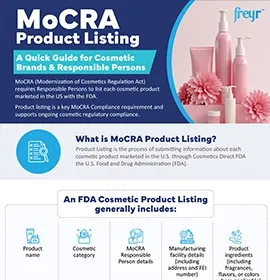
FDA Cosmetic Product Listing | Responsible persons must submit product information through the FDA Cosmetics Direct Portal. Product Listing Includes:
|
Safety Substantiation | Companies must maintain adequate safety substantiation demonstrating that cosmetic products are safe under their intended conditions of use. Documentation should include ingredient safety, formulation risks, toxicological assessments, and supporting scientific evidence. |
Labeling Compliance | Cosmetic labels must comply with MoCRA labeling requirements.
|
Adverse Event Reporting | Responsible persons are required to report serious adverse events associated with cosmetic products to the FDA using electronic or paper submission methods. |
Effective post-market surveillance is critical for ensuring ongoing FDA Cosmetic Compliance and minimizing Regulatory risks.
Common Challenges in MoCRA Compliance
Many companies face difficulties implementing new MoCRA requirements, particularly as Regulatory expectations evolve.
Common challenges include:

Determining whether facility registration obligations apply

Managing product listing requirements across large portfolios

Conducting comprehensive Safety Substantiation
Ensuring cosmetic labeling compliance

Establishing adverse event reporting procedures

Maintaining regulatory documentation and records

Interpreting changing FDA guidance and expectations

Coordinating compliance activities
Without a structured compliance strategy, organizations may encounter delays, increased Regulatory scrutiny, and operational inefficiencies.
How Can Freyr Help?
Freyr provides comprehensive Regulatory compliance services designed to support companies throughout the product lifecycle and help them meet all applicable MoCRA Requirements.
Our Regulatory experts assist with:

Obtaining FEI Number, Facility Registration & US Agent Services
With 500+ facility registrations completed across multiple product categories over the last three years, Freyr helps cosmetic manufacturers achieve MoCRA compliance through seamless FDA facility registration. For facilities located outside the United States, Freyr can also serve as your designated US Agent, ensuring smooth communication with the FDA and regulatory readiness.

Product Listing
Freyr has successfully registered 5,000+ products with the US FDA in the last three years. Our experts simplify and accelerate the product listing process, helping you save time, reduce administrative burden, and ensure compliance with FDA requirements.

Safety Substantiation
Demonstrate product safety with confidence. Freyr provides expert toxicological evaluations, ingredient assessments, and safety substantiation support to help you meet regulatory expectations and substantiate the safety of your cosmetic formulations.

Regulatory Labeling
Processing 25,000+ labels annually across diverse product categories, Freyr delivers compliant, market-ready labeling solutions. Our services include regulatory label reviews, label design, harmonization, QR codes, and smart labeling solutions to help you meet current regulatory requirements.

Adverse Event Reporting
Establish a robust Adverse Event Reporting (AER) framework with Freyr's expert guidance. From adverse event data collection and evaluation to reportability assessments and compliance processes, we help you build and maintain effective post-market surveillance systems.
Why Choose Freyr?
Navigating the complexities of MoCRA requires Regulatory expertise, industry knowledge, and a proactive approach to compliance. Freyr combines deep Regulatory experience with global delivery capabilities to help cosmetic companies achieve and maintain compliance efficiently.

Global Regulatory Expertise
Our specialists support cosmetic companies across diverse markets and evolving regulatory frameworks.

End-to-End Compliance Support
From FDA Cosmetic Facility Registration and product listings to safety assessments and labeling reviews, we provide comprehensive support throughout the compliance journey.

Risk-Based Regulatory Approach
We identify compliance gaps early and develop practical strategies to help reduce regulatory and business risks.

Scalable Solutions
Whether managing a single product launch or a large global portfolio, our services are tailored to your business requirements.

Trusted Regulatory Partner
Freyr supports organizations with reliable, science-based, and compliance-focused solutions that facilitate market access and long-term regulatory success.
Need Expert Guidance?
Partner with Freyr to simplify MoCRA Compliance, strengthen FDA Cosmetic Compliance, and confidently navigate the evolving landscape of US Cosmetic Regulations. Our experts are ready to support your facility registrations, product listings, labeling reviews, safety assessments, and ongoing Regulatory compliance needs.
Frequently Asked Questions (FAQs)
01. What is MoCRA?
The Modernization of Cosmetics Regulation Act of 2022 (MoCRA) was signed into law on December 29, 2022. It ushers in heightened regulatory oversight for cosmetic products and facilities.
02. What are the key provisions introduced by MoCRA?
MoCRA introduces provisions related to Facility Registration, Product Listing, Cosmetic GMPs, Labeling, Adverse Event Reporting, Safety Substantiation, Records, Mandatory Recall Authority, Small Businesses, Asbestos Testing in Talc-containing cosmetics and evaluating the Safety of PFAS in Cosmetics.
03. What are the labeling requirements introduced by MoCRA?
MoCRA mandates the inclusion of a domestic address, domestic phone number, or electronic contact information for receiving adverse event reports. It also requires labeling of fragrance allergens.
04. What is the significance of Cosmetic GMPs under MoCRA?
Facilities are required to adhere to Good Manufacturing Practices (GMPs) aligning with national and international standards. This regulation aims to ensure that cosmetic products are not adulterated and protect public health.
05. What is the Small Business exemption under MoCRA?
Any business whose average gross annual sales in the United States (US) of cosmetic products for the previous 3-year period is less than $1,000,000, adjusted for inflation, and which does not engage in the manufacturing or processing of the cosmetic products described below, shall be considered small businesses and they are exempt from GMP, Facility Registration, and Product Listing.
- Cosmetic products that regularly come into contact with the mucus membrane of the eye under conditions of use that are customary or usual.
- Cosmetic products that are injected.
- Cosmetic products that are intended for internal use.
- Cosmetic products that are intended to alter the appearance for more than 24 hours under conditions of use that are customary or usual and removal by the consumer is not part of such conditions of use that are customary or usual.
06. Who is Considered a responsible person under MoCRA?
The term “responsible person” means the manufacturer, packer, or distributor of a cosmetic product whose name appears on the product label in accordance with section 609(a) of the FD&C Act or section 4(a) of the Fair Packaging and Labeling Act. The “responsible person” will be responsible for:
- Cosmetic product listing
- Adverse events
- Safety substantiation
- Labeling
- Good Manufacturing Practices (GMP)
- Facility Registration
07. How will I list my multiple product categories under MoCRA?
MoCRA allows “flexible listings”. For flexible listings, companies can submit a single listing for cosmetic products with identical formulations, or formulations that differ only with respect to colors, fragrances or flavors, or quantity of contents.
08. What is a "Product Listing" requirement under MoCRA?
A “Responsible Person” (manufacturer, packer, or distributor of a cosmetic product whose name appears on the label) must list each cosmetic product, including its ingredients, with the US FDA. Additionally, the Responsible Person must update product listing information annually.
09. What is the MoCRA recall?
The MoCRA regulation has now been given legal authority to require a mandatory recall of cosmetics if the FDA determines that the cosmetic product may be adulterated or misbranded under the Food and Drug Cosmetics Act (FDCA) and exposure to the product may cause serious adverse health effects.
10. What is the difference between facility registration and product listing under MoCRA?
For facility registration, manufacturers and processors must register their facilities with the FDA and renew their registration every two (02) years. For product listing, RP must list each marketed cosmetic product with the FDA, including product ingredients, and provide any updates annually.