Contact Us



Client Overview
The client is a global respiratory and sleep therapy medical device manufacturer with a Class II–III product portfolio spanning respiratory therapy devices, oxygen therapy products, ventilatory support systems, masks, and related consumables. With products marketed across regulated regions, the client required a scalable complaint handling framework to support EU MDR post-market surveillance, vigilance reporting, regulatory submissions, and ongoing product safety monitoring.

Background
Under EU MDR 2017/745, complaint handling plays a critical role in post-market surveillance and vigilance. As complaint volumes increased across EU markets, the client needed a structured framework to manage complaint intake, classification, investigation, escalation, documentation, and regulatory reporting without compromising timelines or audit readiness.

Services in Scope

End-to-end EU MDR complaint handling support

Complaint investigation and CAPA coordination

Vigilance reporting and regulatory submission support

Post-market surveillance integration and periodic reporting support

Support for high-volume, multi-market complaint management


Challenge
As complaint volumes increased across EU markets, the client’s existing process became difficult to scale. Manual tracking, inconsistent classification, fragmented data, and investigation delays created pressure on MDR timelines, submission quality, and audit readiness.
Key Challenges

Growing complaint volumes created pressure on internal teams and slowed complaint review cycles.

Mixed serious and non-serious events made consistent MDR reportability decisions difficult.

Manual tracking of reporting windows increased the risk of delayed MDR submissions.

Incomplete complaint records, UDI gaps, and fragmented data created rework and impacted submission readiness.

Root cause documentation and CAPA linkage required stronger evidence, consistency, and traceability.

Process gaps increased the risk of inspection observations and Notified Body findings.

Solution
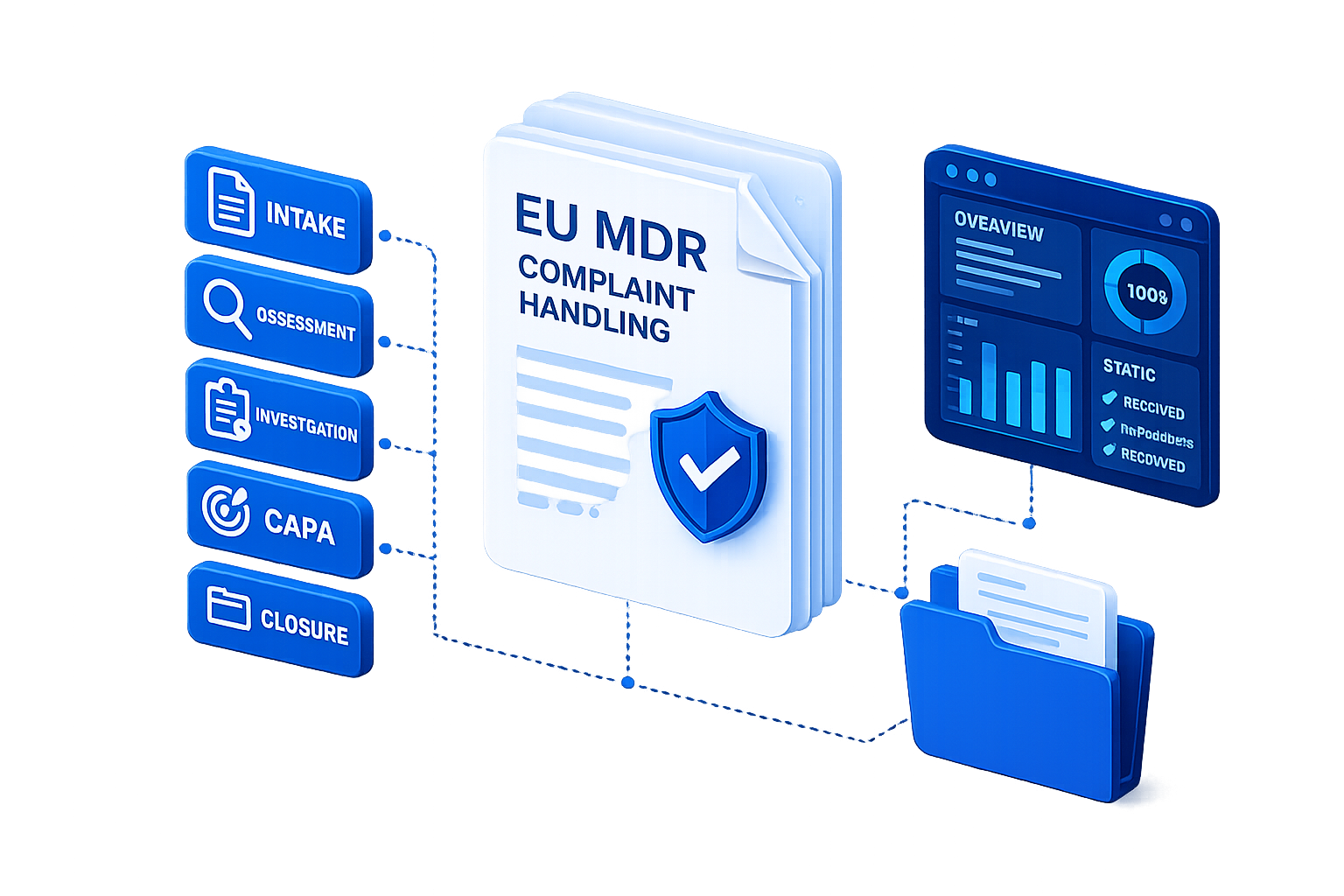
Freyr established a scalable, regulatory-compliant complaint handling framework supported by a dedicated EU MDR regulatory team and QMS-enabled workflows.
1

Standardized complaint intake, triage, routing, documentation, and closure across the complaint lifecycle.
2

Embedded Article 87, 88, and 89 decision logic to improve consistency in MDR reportability assessments.
3

Introduced escalation checkpoints to keep complaint activities aligned with MDR reporting timelines.
4

Reviewed complaint records for completeness, traceability, UDI linkage, and submission readiness. Connected complaint insights with CAPA, PMS, PMCF, and PSUR activities to support closed-loop post-market oversight.
5

Transformed complaint handling from a manual, fragmented process into a governed and scalable framework for timely decisions and compliant documentation..
This transformed complaint handling from a manual, fragmented process into a governed and scalable framework capable of supporting timely decisions, compliant documentation, and closed-loop post-market oversight.

Impact
Freyr helped the client build a scalable complaint handling framework that improved decision speed, strengthened submission discipline, reduced rework, and enhanced audit confidence across EU MDR post-market activities.

Achieved 100% on-time MDR submissions across reportable events.

Secured zero complaint-handling-related Notified Body findings.

Enabled reportability decisions within an average turnaround of less than 48 hours.

Improved EUDAMED first-pass acceptance to 98%, reducing rework and submission delays.

Achieved 92% CAPA closure within the 30-day target through stronger investigation templates and closure tracking.

Reduced internal QA burden while strengthening post-market oversight through CAPA, PMS, PMCF, clinical evaluation, and PSUR alignment.