Consult


5 min read
Medical Device Label Compliance in India Does Not End with CDSCO
For medical device manufacturers entering the Indian market, understanding the LMPC requirements for medical device Labeling is important for a compliant market entry strategy. Labeling is often approached primarily through the lens of CDSCO compliance. While essential, this may not represent the complete India-market labeling obligation.
Chapter VI of India’s Medical Devices Rules, 2017 establishes device-specific labeling requirements. However, medical devices supplied as applicable pre-packaged commodities may also need assessment under the Legal Metrology (Packaged Commodities) Rules, 2011, often referred to as LMPC compliance.
This means a medical device label can satisfy CDSCO requirements and still require additional Legal Metrology compliance.
Understanding Medical Device Labeling and Legal Metrology
India’s Legal Metrology framework governs measurements, quantities, pricing, and mandatory declarations for commodities supplied in the Indian market. For applicable pre-packaged commodities, the principal requirements arise under the Legal Metrology Act, 2009 and the Legal Metrology (Packaged Commodities) Rules, 2011.
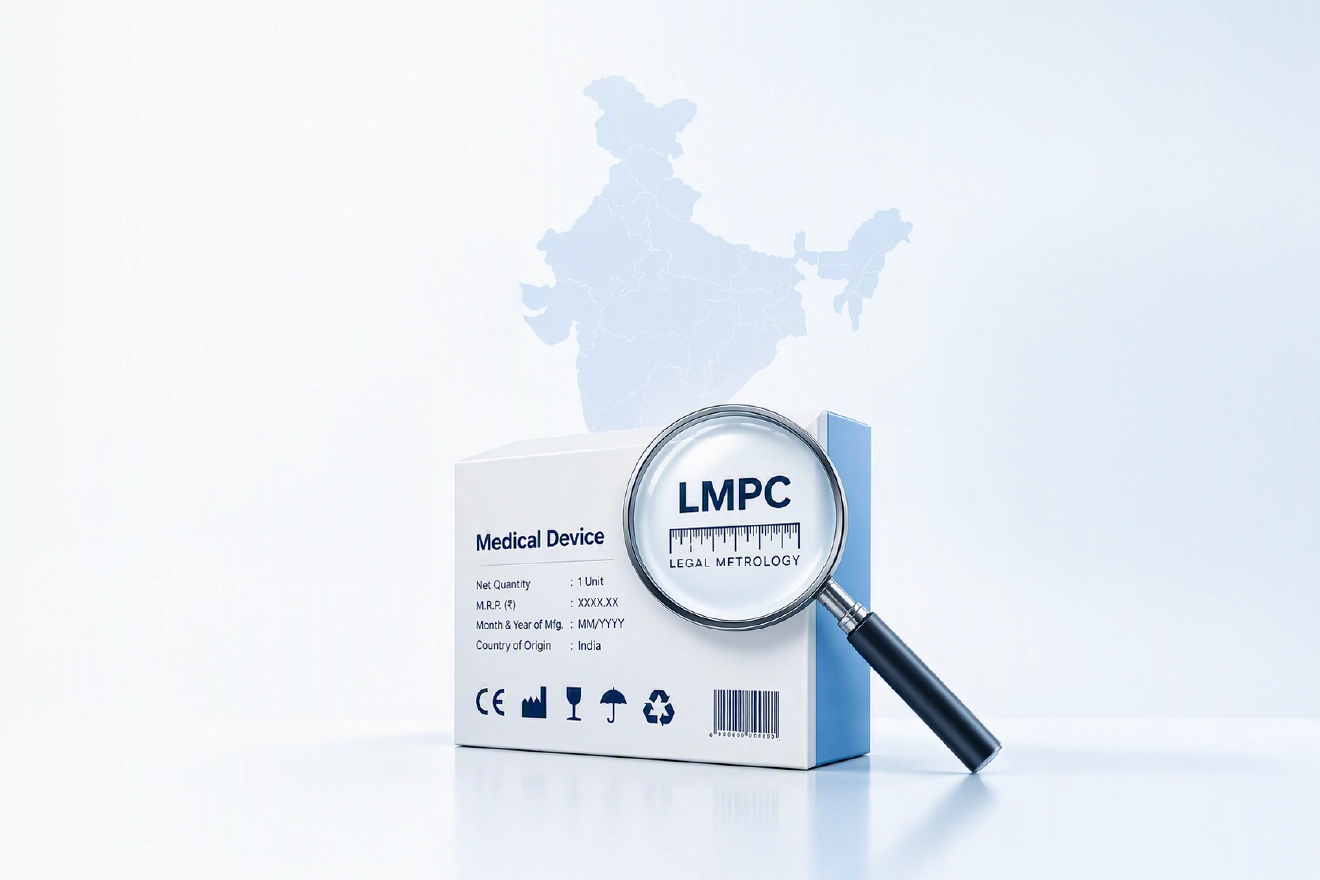
Applicable packages may require declarations such as manufacturer, packer or importer information, country of origin, common or generic name, net quantity, Maximum Retail Price (MRP), consumer-care information, and unit sale price.
The framework also includes registration obligations for manufacturers, packers and importers under Rule 27, where applicable. LMPC compliance can therefore involve both entity-level registration and product-level package compliance.
Why CDSCO Compliance Is Not Sufficient on Its Own
Understanding the Medical Device Labeling Requirements in India means looking at more than one regulatory framework. CDSCO requirements under the Medical Devices Rules and Legal Metrology requirements regulate the same commercial product from different perspectives.
The Medical Devices Rules focus on device identification, traceability, safe use, and regulatory control. Therefore, medical device labeling requirements under MDR in India must be addressed as part of device-specific compliance. Legal Metrology focuses on declarations associated with applicable packaged commodities supplied in India.
This means MDR labeling and Legal Metrology requirements should not be treated as alternative pathways. Where both apply, manufacturers need to ensure that the relevant requirements coexist on the final India-market package.The Department of Consumer Affairs identifies declarations including manufacturer, packer or importer information, country of origin, common or generic name, net quantity, MRP, unit sale price, and consumer-care information.
For teams assessing Medical Device Labeling Requirements, the practical question is not simply whether CDSCO or LMPC applies, but which requirements from each framework must appear on the final packaging. For imported devices, the Labeling requirements for medical devices in India may require global artwork, CDSCO requirements, importer information, and India-specific commercial declarations to be reconciled within one packaging architecture. This is central to effective medical device label compliance.
Global Artwork Can Create India-Specific Compliance Gaps
A globally approved medical device label may still be incomplete for the Indian market. Manufacturers may already maintain artwork designed around EU requirements, FDA labeling regulations, or other global frameworks. However, those labels should not automatically be assumed to meet the Medical Device Labeling Regulations in India.
Global artwork may contain device-specific information yet omit Legal Metrology declarations applicable to the India-market package. Likewise, adding an importer sticker may not resolve compliance if information is incomplete, inconsistent, or incorrectly presented.
The Legal Metrology requirements for medical device labeling in India therefore need to be assessed alongside device-specific requirements when global artwork is adapted for India.
Compliance is also about accuracy and consistency. An importer name, country of origin, MRP, or other declaration may appear on the pack but still conflict with regulatory records, shipment documents, or digital listings.
LMPC Compliance Becomes More Complex as Portfolios Scale
The challenge increases when manufacturers manage multiple SKUs, pack sizes, manufacturing locations, Indian importers, and pricing structures.
For a small portfolio, the LMPC requirements for medical device labels in India may appear to be mainly a label-review exercise. For a larger portfolio, they become a master-data governance and change-control challenge.
The same principle can extend to e-commerce. Where the Packaged Commodities Rules apply, relevant declarations may also need to be reflected in the digital sales environment. This makes alignment between physical packaging and online information important.
Assess LMPC Before Artwork Is Finalized
A recurring mistake is to treat Legal Metrology as a final pre-import check. By then, packaging may already be printed, pricing finalized, importer arrangements fixed, and artwork approved. Any gap becomes a remediation exercise.
A stronger approach is to assess applicable LMPC requirements while the India-market artwork is still being developed. At this stage, teams can reconcile importer information, packaging configuration, pricing declarations, CDSCO requirements, and applicable LMPC requirements for medical device labels in India before artwork enters production.
This shifts compliance from late-stage correction to regulatory design and can reduce rework, regulatory queries, or market-entry delays.
Common Challenges in LMPC Compliance
Implementation can become complex even when the requirements appear straightforward. Applicability and exemptions can vary by product, packaging, and distribution model. Global artwork may lack India-specific declarations, while multiple SKUs can create inconsistencies across pack sizes, importers, and manufacturing sites.
Managing the Legal Metrology requirements for medical device labeling in India, therefore, requires more than checking a standard list of declarations. Manufacturers need to assess how the rules apply to their specific product and commercial configuration.
Mature LMPC programs also reassess compliance when products, importers, pricing, packaging, or regulatory requirements change.
Conclusion: LMPC Is a Market-Entry and Lifecycle Discipline
For medical device manufacturers, Indian label compliance does not end with CDSCO approval. The Medical Devices Rules establish the device-specific labeling framework, while Legal Metrology can introduce additional registration and packaged-commodity requirements depending on the product and commercial model.
Meeting the Medical Device Labeling Requirements in India therefore requires CDSCO and Legal Metrology obligations to be considered together. The strongest medical device label compliance model connects regulation, artwork, and product data throughout the lifecycle.
How Freyr Can Help
Freyr supports medical device manufacturers and importers with LMPC applicability assessment, Rule 27 registration support, label and artwork review, documentation assessment, and ongoing compliance across product portfolios.
For organizations preparing medical devices for the Indian market, speak to a Freyr to assess Legal Metrology requirements and strengthen India-market label compliance before artwork approval or commercialization.