Contact Us


Client Overview
A prominent US-based multinational biopharmaceutical company required comprehensive artwork support for biologics and new molecular entities spanning therapeutic areas such as infections, immunology, pain, and hematology. The organization operated across North America, Europe, APAC, LATAM, the Middle East, and Africa and required multilingual artwork capabilities in languages including Chinese, Japanese, Hebrew, Arabic, and Thai.

Background
The client was experiencing operational disruptions caused by high attrition within internal teams and inconsistent support from external outsourcing vendors. Increasing production volumes and growing artwork demands further intensified the pressure on internal resources.
At the same time, the client maintained stringent quality expectations and rigorous review processes, requiring highly accurate and compliant artwork deliverables across multiple global markets and product portfolios.

Services in Scope

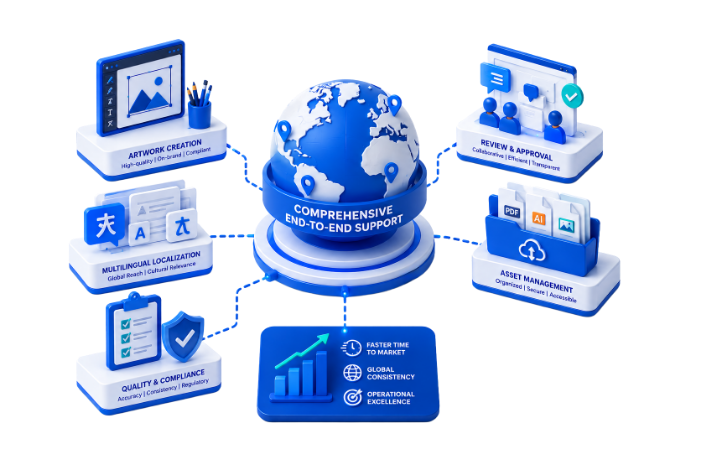
End-to-end artwork creation and lifecycle support

Resource allocation and dedicated artwork operations support

Harmonization of artwork processes across US and Netherlands centers

Review and quality verification of artworks developed internally and by external studios

Creation and management of multilingual artwork components and logos

Streamlining and standardization of artwork workflows across global teams


Challenge
The client faced multiple operational and quality-related challenges:

High attrition reduced internal bandwidth and impacted continuity in artwork operations

Existing outsourcing vendors were unable to meet stringent quality expectations

Growing production requirements demanded scalable and rapid artwork support

Complex multilingual artwork requirements increased review and coordination efforts

Inconsistent processes across different artwork centers created inefficiencies and rework risks

Strict quality review procedures required highly accurate, compliant, and submission-ready deliverables

Solution
1

Dedicated Artwork Support Model
Freyr established a comprehensive support structure with specialized resources dedicated to artwork creation, review, and operational management to address scalability and continuity challenges.
2

Process Harmonization Across Global Centers
Artwork workflows across the US and Netherlands operations were standardized to improve consistency, streamline communication, and reduce operational inefficiencies.
3

Quality-Driven Review Framework
Freyr implemented a robust quality review process focused on right-first-time delivery, ensuring artwork accuracy, compliance, and reduced rework cycles.
4

End-to-End Multilingual Artwork Operations
Comprehensive support was provided for multilingual artwork development, logo creation, and lifecycle management across diverse therapeutic portfolios and global markets.
5

Scalable Operational Execution
Freyr enabled the client to efficiently manage increasing production volumes through scalable delivery models and optimized resource allocation.

Impact
Freyr transformed the client’s artwork operations into a scalable, high-efficiency delivery model capable of supporting growing global demands with consistent quality and operational reliability.
Business Outcomes

Consistent ~2-week delivery per document, even across 1000+ IVDR performance evaluation reports

Achieved 100% quality compliance across artwork deliverables

Delivered 98% right-first-time accuracy, minimizing rework and delays

Maintained 100% turnaround time adherence for timely submissions and launches

Successfully supported global operations across North America, Europe, APAC, LATAM, Middle East, and Africa

Improved operational consistency through harmonized artwork workflows