Consult

2 min read
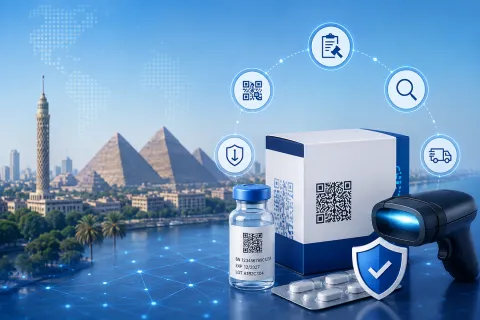
The Egyptian pharmaceutical industry is undergoing a major digital transformation led by the Egyptian Drug Authority (EDA). With the implementation of standard operating procedures under Decrees 475/2025 and 161/2025, pharmaceutical manufacturers, distributors, and importers must align their supply chain operations with national traceability requirements.
Achieving Egypt Pharma Serialization Track and Trace Compliance is no longer just an operational goal—it is now a mandatory requirement for market access. Companies must adopt the right processes and technologies to ensure compliance while maintaining uninterrupted product supply across Egypt.
Key Directives in EDA Pharma Track and Trace Decrees
The EDA pharma track and trace decrees establish a comprehensive framework to combat counterfeit medicines, secure legitimate distribution channels, and improve supply chain transparency.
Decree 161/2025 requires all commercial secondary packaging to include standardized data structures. Decree 475/2025 defines the implementation timelines, reporting requirements, and penalties for non-compliance that apply to both domestic manufacturers and international Market Authorization Holders (MAHs).
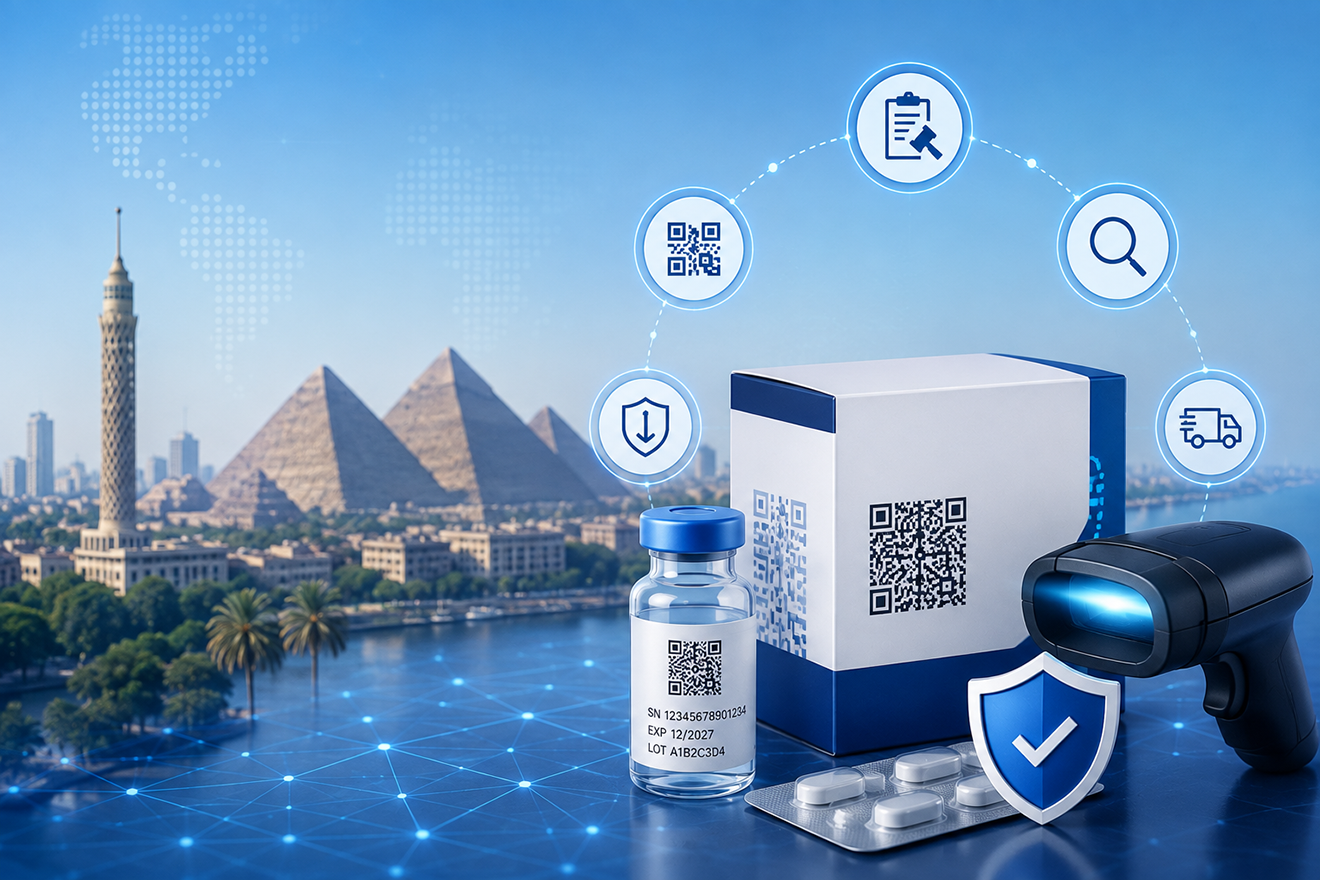
To meet these requirements, pharmaceutical companies must implement advanced printing, vision inspection, and software systems capable of encoding and verifying item-level data. Every saleable pack must carry a unique Global Trade Item Number (GTIN), a randomized serial number, batch information, and an expiration date.
Implementing GS1 2D DataMatrix Packaging Aggregation Egypt Requirements
Compliance begins on the packaging line. Under the GS1 2D DataMatrix packaging aggregation Egypt standard, manufacturers must print high-quality 2D DataMatrix barcodes on every saleable unit.
However, unit-level serialization alone is not enough. Companies must also establish complete parent-child aggregation across every packaging level, including individual packs, bundles, shipping cases, and pallets.
Key compliance checkpoints include:
- Unit-Level Serialization: Print and verify GS1 2D DataMatrix codes using high-speed inline printing and vision inspection systems.
- Packaging Aggregation: Create parent-child relationships linking serialized packs to bundles, shipping cases, and pallets.
- Data Management: Format master data and event data according to EDA integration requirements.
Packaging aggregation creates a complete chain of custody, enabling pharmaceutical products to be tracked efficiently during warehousing, customs clearance, transportation, and wholesale distribution without opening bulk packaging.
Seamless Egyptian Drug Tracking System EDTS Integration
Physical serialization is only one part of compliance. Real-time data exchange is equally important for meeting EDA requirements. Successful compliance depends on seamless Egyptian Drug Tracking System EDTS integration.
The EDTS serves as the national platform that monitors pharmaceutical product movement throughout the Egyptian supply chain.
Market Authorization Holders (MAHs) and logistics partners must establish secure, automated API connections to report serialization events, including serial number generation, commissioning, aggregation, shipment, receipt, and decommissioning. These transactions must be transmitted in EPCIS-compliant formats.
Failure to report accurate data to the EDTS may lead to supply chain disruptions, customs delays, or product release holds.
Mastering Egypt Pharma Serialization Track and Trace Compliance for Sustainable Market Access
Successfully navigating Decrees 475/2025 and 161/2025 requires a combination of Regulatory knowledge, packaging expertise, and reliable enterprise software.
By conducting system readiness assessments, upgrading packaging line infrastructure, and validating software integrations, pharmaceutical companies can achieve Egypt Pharma Serialization Track and Trace Compliance while ensuring continuous product availability, protecting patients from counterfeit medicines, and strengthening trust in the pharmaceutical supply chain.
Connect with our experts to better understand Egypt's serialization and track-and-trace requirements and explore the most suitable compliance approach for your organization.