Consult

4 min read
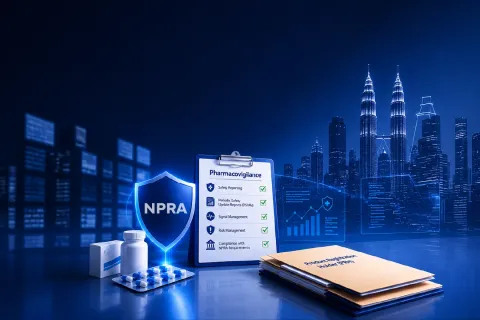
Understanding NPRA Pharmacovigilance Obligations in Malaysia is critical for Product Registration Holders (PRHs) seeking to maintain compliance after product approval. Product Registration Holders (PRHs) face comprehensive and strictly policed post-approval pharmacovigilance (PV) obligations under the National Pharmaceutical Regulatory Agency (NPRA). Most misunderstandings arise from incorrect implementation, incomplete documentation, or a failure to appreciate the unique NPRA-specific requirements.
Below is a deep dive into the nuanced NPRA mandates, with emphasis on the commonly missed elements.
Foundation:
PV System requirement: Every PRH must establish and maintain a PV system tailored to Malaysian legal and regulatory expectations. These Malaysia Pharmacovigilance Requirements must be documented through a Pharmacovigilance System Summary (PVSS) and, where required, a Pharmacovigilance System Master File (PSMF).
Critical Obligations (with Common Failure Points Highlighted)
| Key Obligation | NPRA Requirement | Common PRH Errors or Gaps |
|---|---|---|
| Spontaneous Reporting | Immediate reporting of all serious Adverse Drug Reactions (ADR) and Adverse Events Following Immunization (AEFI) to NPRA. | Delay or incomplete reporting; underestimating timeliness (“inform immediately”), omitting international cases affecting local products. |
| Ongoing Safety Monitoring | Continuous signal detection and benefit-risk assessment of all registered products. | Failing to detect international safety signals; ignoring external regulatory actions which NPRA expects PRHs to proactively monitor. |
| Periodic Safety Update Reports (PSURs)/Periodic Benefit-Risk Evaluation Reports (PBRERs) | Required for all new drugs/biologics—every 6 months for first 2 yrs, annually for next 3 yrs. | Missed deadlines, incomplete data, or not supplying reports when no new data (“no report required” not acceptable to NPRA). |
| Risk Minimization | Implementation of risk management plans (RMPs), communication strategies, and execution of additional risk minimization materials—including QR code protocols for aRMM where NPRA requests. | Failure to localize global RMPs with Malaysia-Specific Annex, or only partially implementing aRMM (e.g., not updating healthcare literature with QR-linked materials). |
| Communication | Mandatory action on NPRA safety alerts, bulletins, DHPCs, and public advisories. DHPCs must be issued to healthcare professionals if NPRA directs. | PRHs often overlook direct communication requirements or delay DHPC distribution, risking non-compliance. |
| Compliance Inspections | PRHs are subject to NPRA GVP inspections (since 2021). | Lacking documented processes, incomplete PVSS/PSMF, or poor audit trails for signal detection and ADR handling. |
| Emerging Safety Issues Notification | All global safety issues must be communicated to NPRA within the stipulated timeline, even before public regulatory action occurs overseas. | Often omitted—PRHs mistakenly believe only local events are reportable. |
| Post-Approval Commitment Reports | Post-registration study data and risk management results must be submitted. | PRHs fail to report post-approval studies or submit reports late. |
| Change Communication | Notify NPRA of any proposed changes to product information, labeling (including e-label/QR), and correspondence details, before implementation. | Changes made before seeking NPRA approval (a breach of CDCR). |
| Product Recall and Corrective Action | Initiate product recall and corrective action, including DHPC and notification, if safety/quality risks mandate it. | Inadequate recall processes; not informing NPRA as required. |
| PV Contact Person Accessibility | A responsible, locally based PV contact must always be available and kept up to date with NPRA. | Details out of date or contact not responsive—triggers potential punitive action. |
Unique NPRA Mandates (Often Missed)
- Malaysian-Specific Annex (MSA): All RMPs must include current, local context (“Malaysia-Specific Annex”)—mere global RMPs are insufficient.
- Adherence to NPRA Timelines: “Immediate” in Malaysia means “as soon as become aware,” not “in the next safety report cycle.”
- Transparency in Global Events: Report emerging global safety issues (e.g., FDA/EMA signals) impacting your product, not just Malaysian cases.
- PVSS & PSMF: Summary AND master file are subject to NPRA review and must reflect actual local practices—not just “on paper” compliance.
- Prompt Updates to Administrative Details: Delay in updating contact details or legal entity changes may lead to regulatory action.
Enforcement and Sanctions
- Inspection: Its outcomes directly affect registration status and are a key component of ongoing NPRA Compliance. Deficiencies may result in product suspension, registration revocation, or regulatory sanctions.
- Failure to Comply: Any breach—reporting, communication, quality, recall—may trigger serious consequences, including market withdrawal.
Summary
- PRHs in Malaysia must implement an NPRA-compliant pharmacovigilance system and maintain continuous adherence to NPRA Pharmacovigilance Obligations in Malaysia, including spontaneous reporting, signal detection, risk management, and ongoing safety monitoring.
- Common errors include delay/failure to report, non-localization of global safety communications, incomplete PSUR submissions, and missing Malaysia-specific regulatory actions.
- Specific NPRA expectations—such as “immediate” reporting, updates on global events, maintaining up-to-date PV contacts, and prompt compliance with Direct Healthcare Professional Communication—are frequently overlooked but strictly enforced.
- Regulatory consequences can be severe: registration suspension, withdrawal, or legal sanction.
To learn about how Freyr can support your Regulatory needs in Malaysia, fill out the contact form or write to us at malaysia@freyrsolutions.com.

About the Author
Zulkhurnain Utar is a professional Regulatory Subject Matter Expert with more than 16 years of APAC/ASEAN regional regulatory affairs in Medical Devices, Pharmaceuticals & Consumer products regulated industries.
Having extensive R & D experience in preclinical toxicology. Competent and knowledgeable in PIC/S GMP for pharmaceuticals, OECD-GLP, FDA’s Quality Systems Regulations, EU Medical Device Regulations (MDR 2017/745 & IVDR 2017/746, MDD 93/42/EEC), QMS ISO 13485, ISO 14971 Medical Devices Risk Management, Conformity Assessment & CE Marking, Biocompatibility Testing ISO 10993, HACCP & Codex Alimentarius, Good Clinical Practice (GCP) and GHS for chemicals.