Consult


3 min read
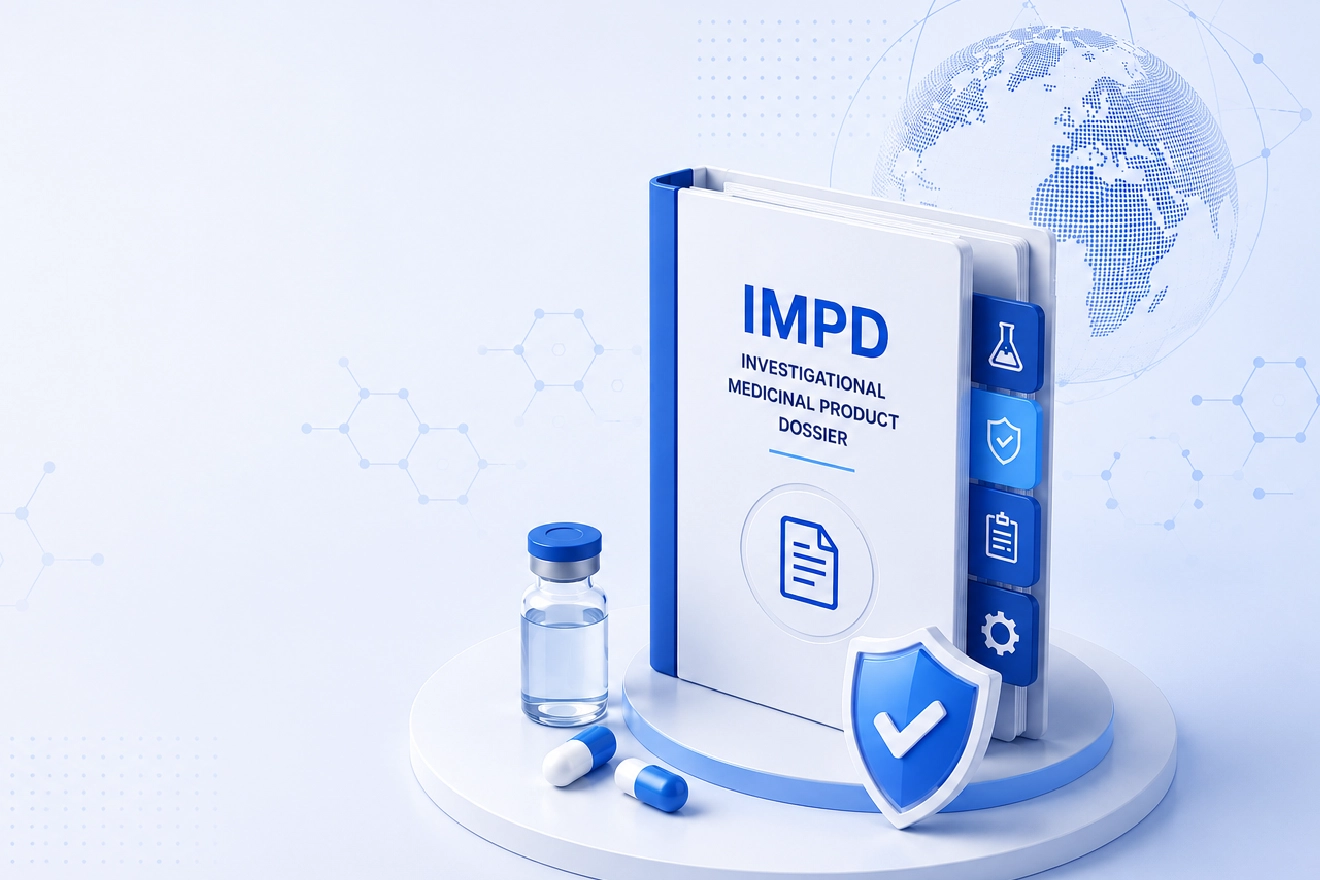
When a sponsor wants to conduct a clinical trial in the European Union, the European Economic Area, or other regions that follow the European model, one document, focused primarily on the Clinical Trial Application, is the Investigational Medicinal Product Dossier (IMPD).
The IMPD is, in many ways, the European equivalent of the CMC and the supporting safety sections of a US IND. Its purpose is the same; its structure, format, and expectations differ in important ways. Sponsors who underinvest in IMPD preparation are also the sponsors who face the most CTA clarifications.
What Is an IMPD?
The IMPD is a structured document that provides Regulatory authorities with the quality, manufacturing, nonclinical, and clinical information necessary to assess whether an investigational medicinal product (IMP) is safe for administration to humans in a proposed clinical trial. It is broadly equivalent to the CMC and supporting safety sections of a US IND, but it follows EMA-specific structure and content guidance.
Submission expectations are guided by EMA's Guideline on the Requirements for Quality Documentation Concerning Biological Investigational Medicinal Products in Clinical Trials and the corresponding chemical IMP guideline (EMA/CHMP/QWP/545525/2017).
Structure of an IMPD
An IMPD is organized into four main sections. The Quality Section covers the drug substance (S) and drug product (P), with appendices (A) covering facilities, adventitious agents safety, and novel excipients where applicable. For drug substance, expect content on nomenclature, structure, manufacture, characterization, control of materials, control of critical steps, specifications, analytical procedures, validation, batch analysis, reference standards, container closure, and stability. For drug product, content includes composition, pharmaceutical development, manufacture, control of excipients, control of drug product, reference standards, container closure system, and stability data.
The Nonclinical Section summarizes pharmacology, pharmacokinetics, and toxicology. The Clinical Section summarizes prior clinical experience. The Overall Risk-Benefit Assessment ties these sections to the trial population, dose, and study duration.
Simplified IMPD
When a trial uses an IMP that is already authorized in the EU and is being used in accordance with the Summary of Product Characteristics (SmPC), a Simplified IMPD may be acceptable. This significantly reduces the dossier burden but applies only where regulatory and clinical conditions are met. Misjudging eligibility for a Simplified IMPD is a common cause of CTA deficiency.
When Is an IMPD Needed?
An IMPD is required as part of the CTA package for Phase I, II, and III clinical trials in the EU/EEA and—in similar form or as a reference document—for several other regions. Updates are required for substantial modifications affecting product quality, formulation, or manufacturing.
Comparison with the US IND CMC Section
Both documents cover similar scientific ground but differ in format and emphasis. The IMPD is more standardized in structure, with explicit expectations for each subsection. The IND CMC section is more flexible in format, but should still contain comparable scientific content. Sponsors planning a multi-region trial often build a single, well-controlled CMC content master and then format it appropriately for each regulator's expectations.
Common Pitfalls
IMPD review challenges typically cluster around a few recurring themes: insufficient drug product stability data to support proposed shelf life and trial duration; incomplete characterization of impurities and degradation products; missing comparability data after process or scale changes; inconsistent specifications between sections; missing TSE/BSE statements for biologics or biological-derived materials; inadequate batch analysis data for clinical batches; and weak risk-benefit framing relative to the proposed dose and population.
Each of these issues is preventable with a phase-appropriate, science-led approach.
A Phase-Appropriate, Risk-Based Approach
The level of detail expected in an IMPD scales with the development phase. A Phase I IMPD may have less stability data and validation than a Phase III IMPD, but quality must always be assured. Regulators understand that early-phase products are still being characterized; what they will not accept is the absence of a coherent control strategy or insufficient justification for the proposed dose and exposure.
For advanced therapy medicinal products (ATMPs)—gene therapies, cell therapies, and tissue-engineered products—IMPD expectations include additional content on starting materials, vector design, viral safety, potency assays, and donor eligibility. ATMP IMPDs are typically more demanding than chemical or biological IMPDs and benefit from very early dialogue with EMA's CAT (Committee for Advanced Therapies).
Maintaining the IMPD Across the Trial Lifecycle
An IMPD does not stop at the first submission. As the trial progresses, manufacturing sites may change, batches may be re-released, stability data will mature, and impurity controls may evolve. Each material change typically requires a substantial modification submitted via CTIS (in the EU) or the equivalent regional channel. Sponsors who maintain a single, version-controlled CMC content master—mapped to both IMPD and IND CMC formats—reduce duplication, improve consistency, and respond to regulator questions faster.
How Freyr Can Help
Freyr's Regulatory experts author IMPDs across Quality, Nonclinical, and Clinical sections for chemical, biological, and advanced therapy IMPs. We assess eligibility for Simplified IMPDs, prepare phase-appropriate dossiers aligned with EMA guidance, conduct CMC gap analyses, and manage updates required for substantial modifications. For multi-region trials, we harmonize IMPD content with US IND CMC and other regional CMC packages so that sponsors maintain a single source of Regulatory truth. Contact us to know more.