Consult

2 min read
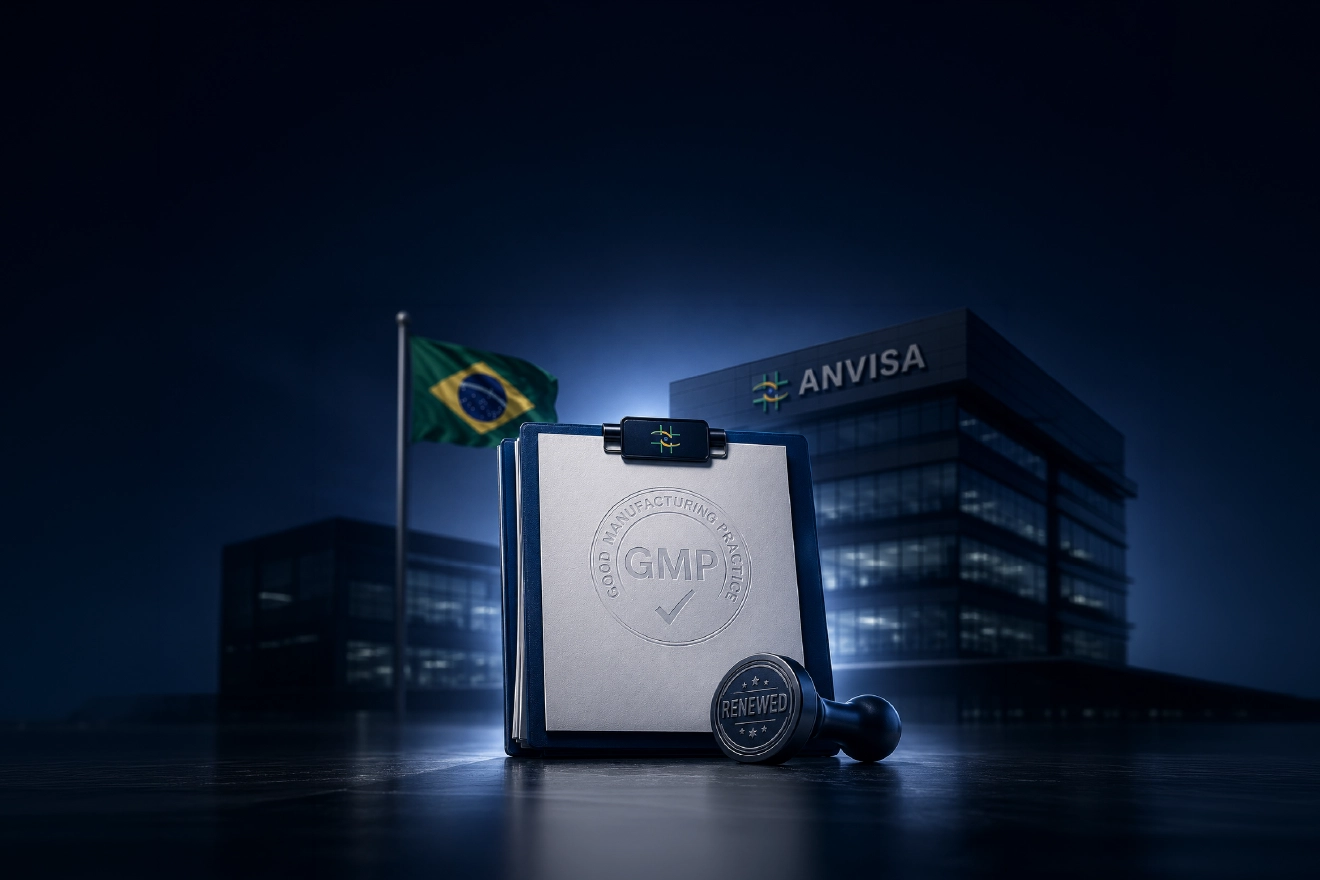
GMP Renewal at ANVISA: What Recurring Compliance Actually Looks Like
Most regulatory teams operating in Brazil have a working sense of when to activate external support. The triggers are well understood: initial registration, an upcoming inspection, a compliance gap that surfaces under pressure. Each of these has a clear place in the operational calendar. GMP renewal does not. Not because it is unimportant — but because it does not fit neatly into any of the categories the team already recognizes. That misclassification is where the problem begins.
The evaluation ANVISA actually runs
A GMP certification is often treated as a fixed point of reference — a credential that, once obtained, speaks for itself. What ANVISA evaluates at renewal is something different. The agency is not taking a photograph of the current state of the quality system. It is reading a longitudinal record: how the system has performed and evolved while the operation was running.
That distinction carries real consequences. Personnel changes, process adjustments, product variations, new manufacturing lines — all of these reshape the operational reality without necessarily triggering a documentation update. A company that managed its initial GMP certification rigorously can arrive at renewal with meaningful gaps that simply did not exist at the time of first approval. The gaps are not the result of negligence. They are the result of treating renewal as a static event in a dynamic operation.
The gaps are not the result of negligence. They are the result of treating renewal as a static event in a dynamic operation.
What the engagement data shows
Across multiple engagements in Brazil, a consistent pattern emerges. Companies seeking external regulatory support do not typically arrive at the beginning of a GMP cycle. They arrive at an inflection point within it — a QA consultation that uncovers something, a compliance review that reveals how much has shifted since the last audit, an operational change that needs to be properly documented before the renewal window activates.
In each of these cases, the service deepens over time. What begins as a focused consultation evolves into structured support because the cycle demands it — not because a crisis forced the issue. GMP renewal is not an isolated event. It is the visible moment of a cycle that has been accumulating quietly for months, sometimes years.
GMP renewal is not an isolated event. It is the visible moment of a cycle that has been accumulating quietly for months, sometimes years.
The companies that arrive well-prepared at renewal are not the ones that reacted faster. They are the ones that reclassified the event early — treating GMP renewal not as an administrative deadline but as a cycle that requires continuity of attention. In a market where ANVISA’s evaluation looks backward as much as it looks at the present, that distinction is precisely what separates a smooth renewal from an expensive one.
If your company is operating in Brazil and the renewal window is within the next 18 months, the time to assess your documentation and system coherence is now — not when the notification arrives. Freyr’s team in Brazil has supported manufacturers through multiple consecutive GMP renewal cycles. We can help you understand where your current system stands.