Consult

4 min read
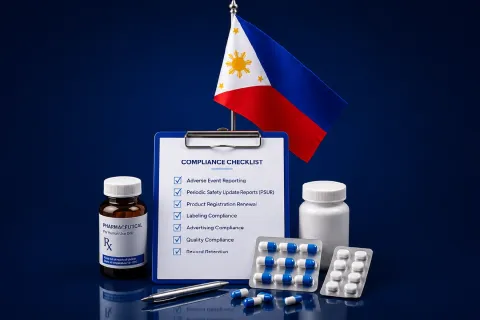
FDA Philippines Post-Marketing Compliance is critical for companies seeking to maintain their products on the market after receiving Regulatory approval. Marketing Authorization Holders (MAHs) in the Philippines must observe ongoing Regulatory compliance to maintain their drug products on the market after receiving product registration.
The Food and Drug Administration (FDA) enforces a robust regime of post-marketing requirements designed to safeguard public health, ensure product efficacy and quality, and support early detection and mitigation of safety risks.
Below is a detailed breakdown of the specific duties, timelines, and Regulatory obligations:
1. Product Quality, Safety, and Efficacy Maintenance
- Continuous Obligation: MAHs are responsible for ensuring that all distributed batches of their registered drugs continue to comply with the standards for safety, efficacy, and quality as defined during registration and reflected in the Certificate of Product Registration (CPR).
2. Pharmacovigilance and Post-Marketing Surveillance (PMS)
- Adverse Event Reporting:
- Pharmacovigilance Philippines requirements mandate that MAHs must establish an internal system for collecting and evaluating adverse drug reactions (ADRs) and adverse events (AEs) post-registration.
- Serious/unexpected ADRs should be reported to the FDA’s Center for Drug Regulation and Research (CDRR) within 5 calendar days.
- All other ADRs or safety issues are subject to regular reporting schedules, usually with Periodic Safety Update Reports (PSURs) or Periodic Benefit-Risk Evaluation Reports (PBRERs).
- If a product is withdrawn from the market, MAHs must continue reporting ADRs for three years after the last batch release.
- Pharmacovigilance System:
- Documented procedures should be in place for monitoring, evaluation, and timely reporting of post-marketing issues.
- MAHs must designate a qualified pharmacovigilance contact and make records available during audit or inspection.
3. Reporting and Managing Post-Approval Changes
- Notifications and Approvals:
- Any post-approval change (e.g., manufacturing site alteration, change in formulation, labeling updates, supply chain addition, or modifications in shelf life) must be reported to the FDA accordingly.
- Some changes require FDA approval before implementation; others are subject to notification with subsequent compliance checks.
- Labeling and Product Information:
- MAHs must ensure that updated Product Information (PI) or Patient Information Leaflets (PIL) are submitted as changes occur and published on the FDA Verification Portal.
4. Renewals and Validity of Registration
- CPR Renewal:
- Certificate of Product Registration (CPR) Renewal is a critical Regulatory requirement, as MAHs must submit complete renewal applications before the registration expires to maintain legal market authorization.
- Evidence of compliance with all post-marketing and safety obligations must be included with renewal submissions.
- Failure to apply for renewal or fulfill requirements leads to delisting and removal from the market.
5. Good Manufacturing Practice (GMP) and FDA Inspections
- Compliance and Record Keeping:
- MAHs must guarantee that all manufacturers—and any site involved in the supply chain—comply with current Good Manufacturing Practices (cGMP).
- Cooperation with routine and triggered FDA inspections/audits is mandatory; non-conformity can result in suspension or revocation of market authorization.
6. Notification of Recalls and Product Withdrawals
- Recall Procedures:
- If a product quality or safety issue is detected post-distribution, the MAH must notify the FDA and follow prescribed product recall procedures immediately.
- All actions and communications from recall must be documented as per FDA protocols.
7. Electronic Dossier Maintenance
- Documentation:
- Maintain updated, accessible electronic dossiers of the full registration documentation, including all post-marketing changes, safety reports, and correspondence.
- Ensure readiness for submission to the FDA upon request or during renewal/inspection.
8. Special Categories: Biologicals and Dangerous Drugs
- Augmented Surveillance:
- For high-risk drugs such as biologicals, vaccines, or dangerous substances, additional obligations (e.g., seasonal safety updates, study results, or enhanced surveillance) may be mandated as specific conditions in the registration.
- Interim and final clinical study results are often required during post-marketing for these categories.
Key Table – Ongoing MAH Compliance Commitments
| Requirement Area | MAH Obligation | Reporting/Action Period |
| Adverse Event (AE/ADR) | Submit reports to FDA CDRR | Serious and significant safety reports should be submitted or reported in accordance with the timelines specified in FDA Circular No. 2020-003 (Guidelines for Pharmaceutical Industry on Pharmacovigilance) |
| Safety Update Reports | Submit PSUR/PBRER and ongoing PMS evidence | In accordance with the timelines specified in FDA Circular 2020-003 |
| CPR Renewal | Submit renewal with evidence of compliance | Can be submitted as early as 90 days before the CPR expiration. |
| Post-Approval Changes | Notify/apply for approval before implementing changes | Prior to implementation |
| Electronic Dossier | Maintain and provide upon request | Continuous maintenance of complete Regulatory documentation to facilitate inspections, renewal and lifecycle submissions. |
| Recalls/Withdrawals | Notify FDA and follow recall procedures | Immediately upon issue detection |
| Package Information Update | Submit changes and publish on FDA portal | As required |
| GMP and Supplies | Ensure all sites meet cGMP and cooperate with inspections | Continuous |
Summary
- Maintaining FDA Philippines Post-Marketing Compliance requires MAHs to continuously meet pharmacovigilance, post-marketing surveillance, CPR renewal, GMP, recall, and documentation requirements throughout the product lifecycle.
- Reporting post-approval changes, updating information leaflets, and maintaining documentation are ongoing mandatory tasks.
- Biologicals and other special categories also require enhanced vigilance and additional reporting.
- Strict Regulatory adherence is essential for continued market presence and to avoid sanctions or product withdrawal.
Click here to know more about our services: Medicinal Products Regulatory Support in Philippines | Freyr - Global Regulatory Solutions and Services Company
To learn more about how Freyr can support your Regulatory needs in Philippines write to us at sales@freyrsolutions.com.
 | Jocelyn B. Parto is a registered pharmacist with over 19 years of experience in pharmaceutical Regulatory affairs, quality assurance, and pharmacovigilance. She has extensive expertise in product registrations, renewals, variations, lifecycle management, GMP compliance, and Regulatory strategy across pharmaceuticals, medical devices, food, nutritional products, and cosmetics. Throughout her career, she has successfully supported local and regional Regulatory submissions, health authority interactions, inspection readiness, and post-approval compliance activities. Her strong understanding of ASEAN Regulatory frameworks and pharmacovigilance requirements enables organizations to navigate complex Regulatory landscapes while maintaining product quality, safety, and compliance. |
FAQs
Q1: What are the reporting timelines for adverse drug reactions (ADRs)?
Serious Adverse Drug Reaction must be reported as soon as possible but not later than 15 days
Q2: What happens if an MAH fails to renew its Certificate of Product Registration (CPR) on time?
If a CPR expires without timely renewal, the drug product cannot legally remain on the Philippine market. Additionally, delayed renewal or non-compliance with post-marketing obligations may result in product delisting or market withdrawal.
Q3: Are post-approval changes to a drug product allowed without FDA notification or approval?
No, all significant post-approval changes (such as manufacturing process, site, formulation, labeling, or supply chain) must be reported to and, if required, pre-approved by the FDA before they can be implemented. Failure to comply may lead to Regulatory sanctions or suspension of market authorization.