Consult

1 min read
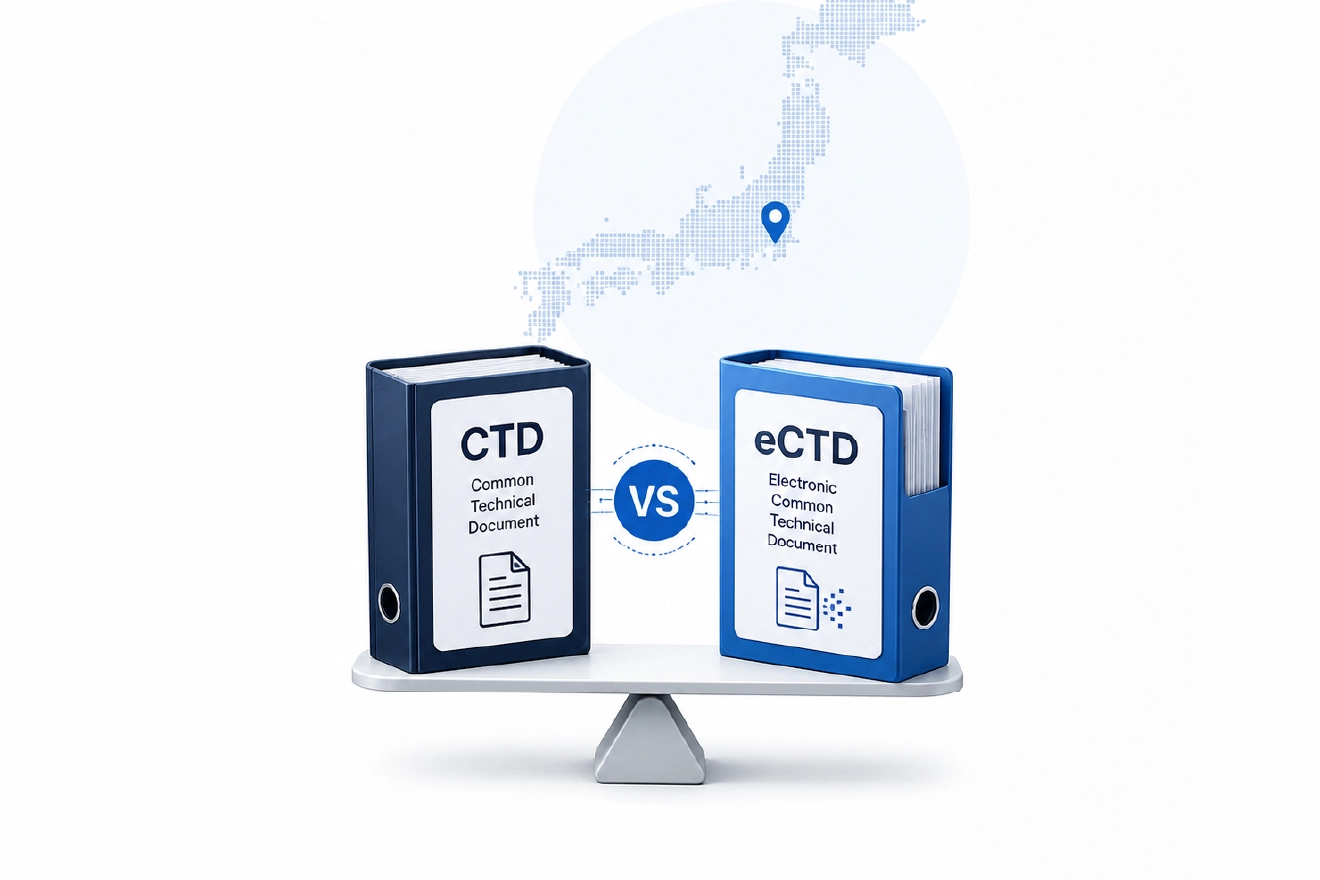
For pharmaceutical companies preparing to enter the Japanese market, one of the most common questions is whether to submit a Common Technical Document (CTD) or an electronic Common Technical Document (eCTD). While both formats contain the same scientific and regulatory information, the method of preparation, submission, and lifecycle management differs significantly.
Understanding PMDA's expectations is essential to avoid submission delays and ensure regulatory compliance.
Understanding CTD and eCTD
The CTD is the internationally harmonized format developed under the International Council for Harmonisation (ICH). It organizes regulatory information into five modules covering administrative information, quality, non-clinical studies, and clinical data.
The eCTD, however, is the electronic version of the CTD. It follows a structured XML-based format that allows regulators to review, track, and manage submissions digitally throughout the product lifecycle.
While the scientific content remains the same, eCTD significantly improves document organization, navigation, lifecycle tracking, and regulatory communication.
What Does PMDA Require?
Japan's Pharmaceuticals and Medical Devices Agency (PMDA) supports electronic submissions and has progressively advanced its digital regulatory environment. Today, eCTD is the preferred submission format for new drug applications, variations, and lifecycle activities, enabling more efficient regulatory review and document management.
Companies preparing Japan submissions should ensure:
- CTD content is fully aligned with PMDA requirements.
- Module 1 is localized for Japan.
- eCTD structure complies with PMDA validation criteria.
- Hyperlinks, bookmarks, file naming, and publishing standards are validated before submission.
- Lifecycle sequences are properly managed throughout the product's regulatory journey.
- Common Challenges During Japan Submissions
- Many global companies encounter difficulties not because of the scientific data, but because of submission readiness.
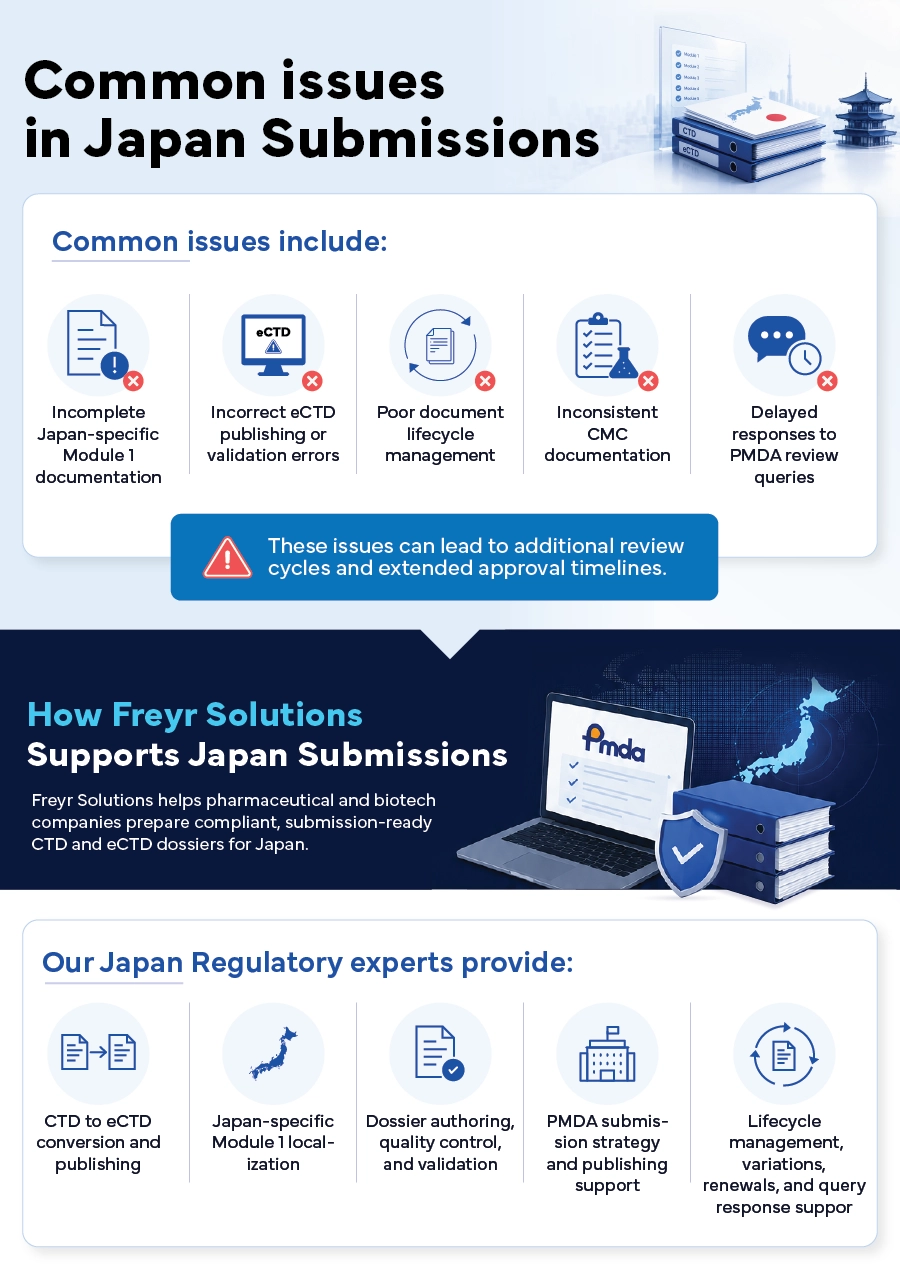
Common issues include:
- Incomplete Japan-specific Module 1 documentation
- Incorrect eCTD publishing or validation errors
- Poor document lifecycle management
- Inconsistent CMC documentation
- Delayed responses to PMDA review queries
- These issues can lead to additional review cycles and extended approval timelines.
- How Freyr Solutions Supports Japan Submissions
- Freyr Solutions helps pharmaceutical and biotech companies prepare compliant, submission-ready CTD and eCTD dossiers for Japan.
- Our Japan Regulatory experts provide:
- CTD to eCTD conversion and publishing
- Japan-specific Module 1 localization
- Dossier authoring, quality control, and validation
- PMDA submission strategy and publishing support
- Lifecycle management, variations, renewals, and query response support
Whether you are a global company entering Japan or a Japanese manufacturer expanding internationally, Freyr combines local regulatory expertise with global operational excellence to help accelerate approvals and reduce regulatory risk.
A well-prepared CTD is only the foundation. Successful submissions in Japan increasingly depend on high-quality eCTD publishing, validation, and lifecycle management aligned with PMDA expectations.
Partner with Freyr Solutions to ensure your Japan submissions are accurate, compliant, and submission-ready—from dossier preparation through approval and beyond.