Beraten lassen


8 Min. Lesezeit
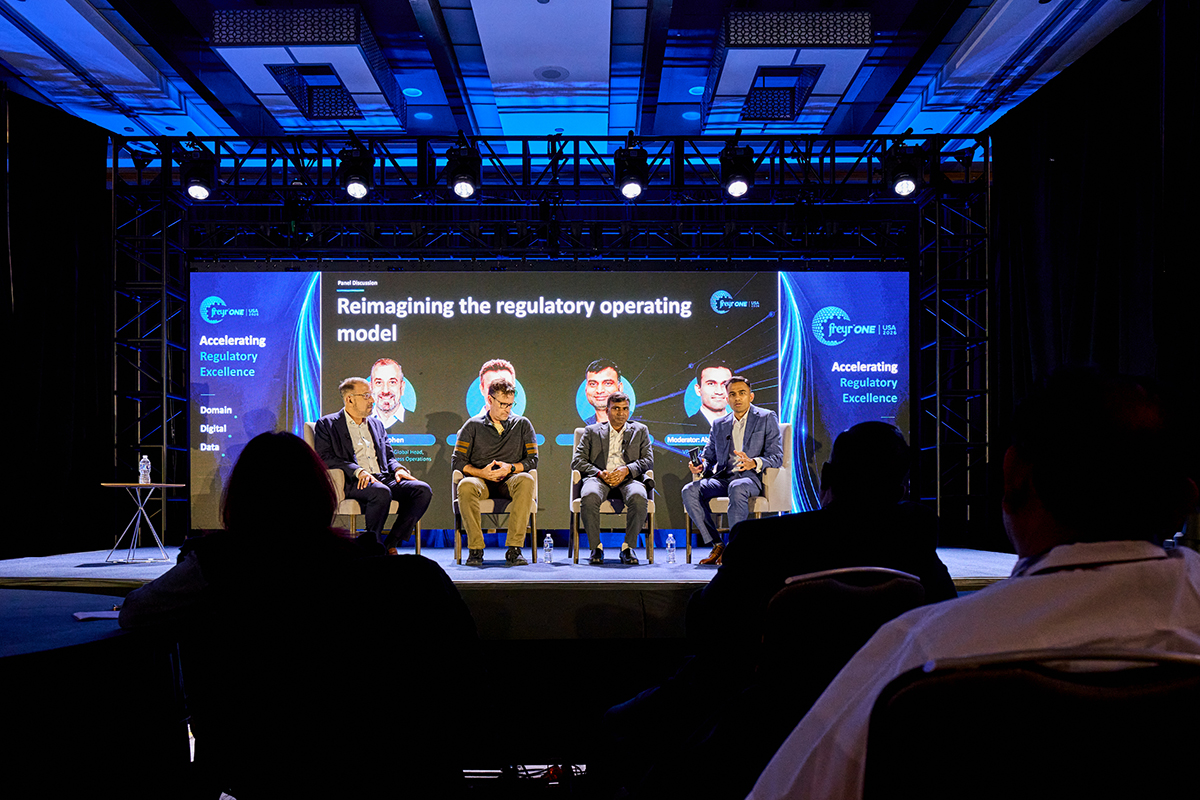
At Freyr One USA 2026, industry leaders including Jack Cohen (Takeda), Andrew Robertson (Denali Therapeutics), and Sathya K (Freyr Solutions) came together for a candid discussion on what it means to reimagine the life sciences regulatory operating model in the age of AI. The conversation explored a question many life sciences organizations are currently grappling with: while AI adoption may be inevitable, what does it take to prepare an organization to realize meaningful value from it? Spanning topics such as process maturity, operating model design, scalability, change management, partnerships, and workforce transformation, the discussion revealed a recurring theme: organizations that focus solely on AI tools will struggle to realize value. Future-ready operating models will be built on strong foundations, adaptable structures, and a workforce prepared to work alongside AI.
AI adoption is accelerating, but most life sciences organizations are still in the early stages
The discussion began with an interesting perspective on the industry's current state of AI adoption. Drawing from observations across multiple organizations, the panel reflected on the fact that while AI is dominating strategic discussions, most regulatory functions remain at a relatively early stage of maturity. Many organizations are experimenting with pilots, testing isolated use cases, or introducing general-purpose AI assistants, but relatively few have achieved enterprise-wide integration or connected AI-enabled workflows.
This gap between excitement and adoption is important. The challenge facing regulatory leaders is no longer deciding whether AI will become part of the operating model. That question has largely been answered. The more pressing challenge is determining how to build the processes, governance structures, and organizational capabilities required to make AI effective at scale.
The panel emphasized that AI should not be viewed as a discrete technology initiative. Instead, it should be considered part of a broader operating model transformation. Organizations that treat AI as a collection of isolated projects are likely to see local improvements but may struggle to generate meaningful business impact.
Process maturity remains the foundation for successful transformation
One of the strongest themes throughout the discussion was the importance of process maturity. While much industry attention is currently focused on AI capabilities, the panel argued that technology can only be as effective as the processes it supports. Life sciences organizations that attempt to automate fragmented or inconsistent workflows are often disappointed by the results.
Several examples highlighted the value of first establishing standardized ways of working, ensuring clear governance structures, and improving data quality before introducing advanced automation. This creates the consistency required for AI solutions to function effectively across products, therapeutic areas, and regions. As the discussion noted, organizations may feel pressure to move quickly, but taking a measured approach often produces more sustainable outcomes. The point was not that organizations should delay innovation. Rather, they should resist the temptation to view AI as a shortcut around process excellence. Future-ready operating models require both. Process maturity does not slow down AI adoption; it enables it.
The goal is not better pilots. The goal is better business outcomes.
A recurring discussion focused on the industry's tendency to pursue narrowly defined AI use cases without adequately considering broader business objectives. The panel observed that many automation initiatives successfully improve individual tasks or functional processes yet fail to materially improve end-to-end business outcomes. This distinction is critical. Automating a single activity may improve a local KPI, but regulatory organizations are ultimately measured on outcomes such as submission timelines, approvals, product launches, and market access. Improving one process in isolation does not necessarily accelerate those outcomes if the surrounding processes remain unchanged.
The discussion therefore highlighted the importance of thinking beyond functional boundaries. Regulatory work depends on inputs from numerous upstream and downstream functions. If those dependencies remain fragmented, even highly successful automation efforts may struggle to create enterprise-level value. The future operating model requires a more connected view of processes, data, and decision-making across the organization. Thus, it is critical to distinguish between solving functional KPIs and solving business KPIs. Regulatory organizations must increasingly focus on the latter.
Scalability matters more than speed
Another recurring theme was the need to balance urgency with long-term thinking. Organizations understandably want to move quickly and demonstrate progress. However, the panel repeatedly emphasized the importance of evaluating solutions through the lens of scalability.
A successful pilot does not automatically translate into a successful operating model. Some narrowly scoped solutions generate initial excitement but prove difficult to expand, integrate, or sustain over time. Others may solve a highly specific problem but create limited value beyond a single use case. The discussion suggested that leaders should evaluate potential investments not only by their immediate benefits, but by their ability to support future use cases and broader adoption.
Several examples highlighted the value of building reusable capabilities to support AI adoption in regulatory affairs that can serve multiple business problems over time. Organizations that think in terms of platforms, components, and capabilities rather than one-time projects are often better positioned to realize long-term returns from AI investments. Equally important is establishing realistic expectations. Successful transformation requires clear baseline measurements, credible ROI assumptions, and an honest assessment of what is realistically achievable. Organizations that overpromise outcomes often undermine confidence in future innovation efforts.
Great operating models are built through partnerships, not transactions
An interesting part of the discussion focused on the changing nature of partnerships in an AI-driven environment. The panel argued that traditional vendor-customer relationships are often insufficient when building next-generation regulatory capabilities. Future operating models increasingly depend on collaborative partnerships built on trust, shared investment, and joint problem-solving.
The conversation emphasized that partners should play an active role in identifying opportunities, proposing use cases, and helping organizations navigate emerging technologies. At the same time, organizations must be willing to involve partners in longer-term strategic thinking rather than limiting interactions to predefined requirements. Trust emerged as a recurring theme. Whether discussing AI platforms, operating model redesign, or process transformation, participants repeatedly returned to the idea that effective partnerships require transparency, governance, and a shared commitment to achieving outcomes. In an environment where technology continues to evolve rapidly, strong partnerships can provide flexibility and innovation that rigid contractual relationships often cannot.
Centralization alone is not the answer
The discussion also challenged some common assumptions around operating model design. While many organizations pursue centralization as a path to efficiency, panelists emphasized that centralization should not be viewed as an objective in itself. Instead, organizations should determine which activities truly benefit from being centralized, which are better managed regionally, and which require local expertise.
A recurring theme was the need to distinguish between activities that genuinely require country-specific regulatory knowledge and those that can be standardized across markets. Advances in technology, data accessibility, and regulatory intelligence are changing where those boundaries lie. Activities that once required extensive local involvement may increasingly be coordinated through centralized or regional teams, allowing local experts to focus on higher-value activities that depend on market-specific context and stakeholder engagement. The discussion made it clear that there is no universal model. Different organizations have different levels of maturity, different product portfolios, and different strategic priorities. The optimal operating model is therefore highly contextual and must be designed around business needs rather than industry trends.
The future operating model starts with people
Perhaps the most important theme of the discussion was the role of people in enabling transformation. While technology dominated much of the conversation, the panel consistently returned to workforce readiness as the ultimate determinant of success. Regulatory organizations must invest in helping employees understand how AI can augment their work, improve decision-making, and enable more strategic contributions. Education, experimentation, and practical exposure were all identified as critical enablers of adoption. Several participants noted that resistance to AI often stems less from technology concerns and more from uncertainty about roles, expectations, and future ways of working.
The discussion also introduced the idea that life sciences organizations may need a new generation of techno-functional professionals, individuals who understand both regulatory processes and emerging AI capabilities. Alongside formal training programmes, many organizations are experimenting with AI champions, communities of practice, and peer-to-peer learning models to help accelerate adoption and build confidence. Ultimately, the future operating model will not be defined by technology alone. It will be defined by how effectively organizations prepare people to work differently.
Looking ahead: Future-ready life sciences organizations will balance structure with adaptability
As the discussion concluded, a clear vision of the future regulatory operating model emerged. It is not a model built around a single technology, organizational structure, or delivery approach. Instead, it is one that combines strong process foundations with flexibility, scalable technology with practical business outcomes, and innovation with governance.
Most importantly, the panel reinforced that transformation is not a one-time initiative. Regulatory organizations are operating in an environment where technology, data, regulations, and business priorities will continue to evolve. The operating models that succeed will therefore be those designed not only for efficiency, but also for adaptability. For regulatory leaders, the message was clear: future readiness is not achieved by adopting AI. It is achieved by creating an operating model that can continuously evolve alongside it.
Conclusion: Building a Future-Ready Regulatory Operating Model
A future-ready regulatory operating model is not defined by how quickly an organization adopts AI, but by how effectively it connects processes, technology, data, governance and people. Regulatory leaders must look beyond individual automation initiatives and build adaptable capabilities that can scale across products, regions and business functions. As the industry evolves, organizations will need partners who understand both regulatory complexity and the possibilities of digital transformation. Freyr brings together regulatory domain expertise, digital capabilities and data to support organizations in navigating this transformation. The opportunity is not simply to adopt AI, but to rethink how regulatory work gets done.
Discover how Freyr is advancing regulatory intelligence through the convergence of domain expertise, digital capabilities and trusted data.