Reservar una reunión


What is UDI Label Development?
A unique device identifier (UDI) is a series of numeric or alphanumeric characters that uniquely identifies a UDI-labeled medical device through its distribution and use. Achieving UDI-compliant labeling means the identifier appears correctly on every label from the primary device label to outer packaging. Manufacturers are legally required to place a UDI on the label and packaging of their devices in both Human-Readable Interpretation (HRI) and Automatic Identification and Data Capture (AIDC) formats, such as a barcode or DataMatrix.
UDI Label Artwork Development is the process of integrating compliant UDI-DI and UDI-PI identifiers, UDI barcode label elements, including the GS1 DataMatrix UDI carrier and human-readable information, into medical device labels and packaging artwork. It ensures that UDI data is accurately represented across device labels, packaging levels, and associated labeling components while maintaining readability, scan performance, regulatory compliance, and artwork consistency.
Freyr supports the complete UDI implementation lifecycle design, verification, and management, ensuring medical device UDI compliance globally.
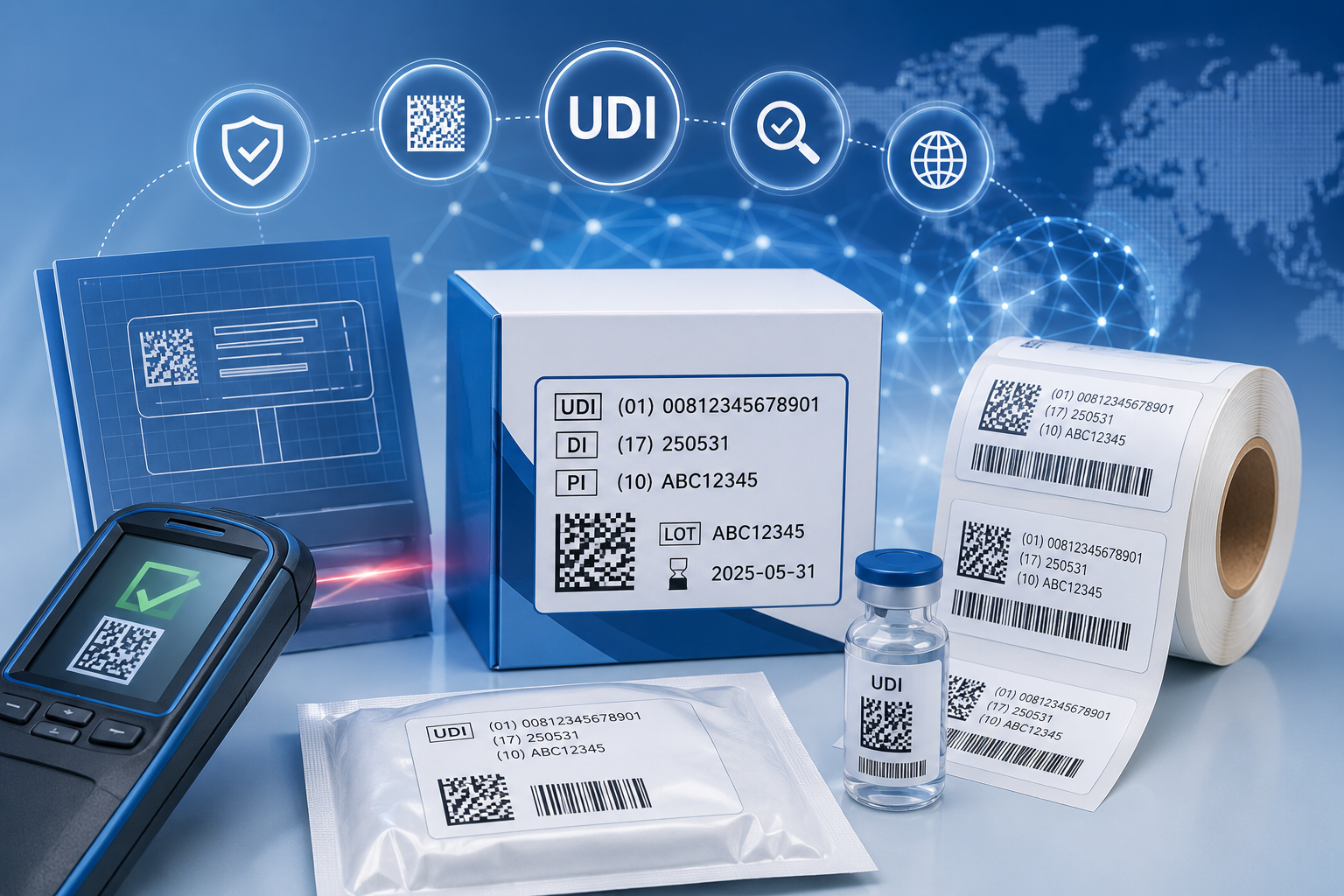
What Freyr Delivers: UDI Service Scope
![]()
UDI Label Artwork Creation
![]()
UDI Barcode Integration
![]()
Human-Readable Interpretation (HRI)
![]()
Packaging Hierarchy Labeling
![]()
Variable Data Architecture
![]()
Global UDI Artwork Deployment
![]()
UDI Artwork Change Management
![]()
Multilingual UDI Labeling


The Two Components of a Complete UDI: UDI-DI & UDI-PI
A complete UDI consists of two mandatory components: the Device Identifier (DI) and the Production Identifier (PI). Understanding the UDI-DI vs UDI-PI difference is critical to correct UDI labeling for medical devices. Both must appear on the device label as HRI (human-readable text) and AIDC (barcode/DataMatrix), encoded together in a single symbol.
UDI-DI : Device Identifier
(Static, Model-Level)
The static portion of the UDI that identifies:
- Fabricante
- Device model
- Device version
- Packaging level
The UDI-DI remains consistent for a specific device configuration and serves as the primary identifier within regulatory databases.
UDI-PI : Production Identifier
(Dynamic, Lot/Serial-Level)
The dynamic portion of the UDI may include:
- Lot number
- Número de lote
- Serial number
- Fecha de fabricación
- Fecha de caducidad
- Software version
The UDI-PI enables unit-level or batch-level traceability and is often generated during manufacturing operations.
Choosing the Right UDI Barcode Symbology
A critical part of UDI implementation is selecting the right barcode carrier to accurately encode device identification information and ensure reliable scanning. UDI barcode grade verification as per ISO 15415, using calibrated UDI barcode verification tools, helps ensure consistent barcode readability and supports reliable scanning across manufacturing, distribution, healthcare delivery, and post-market traceability.
The choice between GS1 and HIBC for UDI depends on several factors, including device type, available label space, packaging level, printing technology, issuing agency requirements, and the intended scanning environment. A HIBC barcode label suits HIBCC-registered manufacturers, while GS1-based symbologies have the broadest global acceptance. An improperly selected or poorly implemented barcode can lead to scan failures, supply chain disruptions, regulatory non-compliance, and traceability challenges.
Freyr helps medical device manufacturers understand how to create a UDI label for medical device applications balancing regulatory requirements, operational practicality, and artwork constraints. Whether using BarTender UDI barcode printing or a NiceLabel UDI template workflow, Freyr applies a thorough UDI label quality checklist to maintain optimal label usability and readability.
Recommended For Most Medical Device UDI Applications
The GS1 DataMatrix UDI symbol has become the carrier of choice for regulated healthcare products globally. It supports all GS1 identifiers and Application Identifiers, encoding the complete UDI-DI and UDI-PI in a single compact 2D matrix. Its suitability for UDI direct marking on device surfaces makes it equally valuable for direct part marking on reusable devices.
Ventajas clave
Compact Footprint
GS1 DataMatrix encodes substantial UDI information within a small space, making it ideal for compact labels and small device packaging.
High Data Capacity
A single symbol can accommodate:
- UDI-DI
- Lot number
- Serial number
- Fecha de caducidad
- Fecha de fabricación
- Additional production information
Damage Tolerance
Built-in error correction capabilities allow the barcode to remain readable even if partially damaged during handling or use.
Global Regulatory Acceptance
GS1 DataMatrix is widely accepted across global medical device markets and is commonly used to support UDI requirements under various regulatory frameworks.
Direct Part Marking Compatibility
Suitable for permanent marking technologies such as:
- Laser etching
- Dot peen marking
- Chemical etching
- Molded-in identification
making it the preferred choice for reusable devices requiring lifetime traceability.
For Label considerations, Freyr ensures:
- Proper symbol sizing
- Quiet zone compliance
- Label space optimization
- Human-readable interpretation alignment
- Variable data integration
- Print process compatibility
Standard For Secondary And Tertiary Packaging
The GS1-128 is a GS1-compliant linear barcode based on Code 128 symbology, capable of encoding Application Identifiers including UDI-DI and UDI-PI in sequential data elements. Widely used on secondary packaging (carton) and tertiary packaging (shipper) at distribution centre level. Readable by standard laser scanners. Linear barcode formats can often be scanned from greater distances than small DataMatrix symbols, making them suitable for logistics environments.
For Label considerations, Freyr ensures:
- X-dimension optimization
- Quiet zone management
- Packaging-level barcode selection
- Human-readable interpretation formatting
- Multi-pack and shipper label integration
- Variable data placement planning
For HIBCC Issuing Agency Users
When evaluating GS1 vs HIBC for UDI, while GS1 is the most widely adopted UDI issuing agency, many medical device manufacturers utilize identifiers issued through the Health Industry Business Communications Council (HIBCC).
HIBC barcode structures are designed specifically for healthcare applications and are accepted within many global UDI frameworks.
Different packaging levels frequently require different UDI barcode label implementations. The Basic UDI-DI links all variant UDI-DIs within a device family in EUDAMED, while each packaging level carries its own UDI-DI reflecting the specific configuration.
| Packaging Level | Typical Barcode Approach |
|---|---|
| Device Label | GS1 DataMatrix |
| Sterile Barrier Packaging | GS1 DataMatrix |
| Primary Package | GS1 DataMatrix |
| Secondary Carton | GS1 DataMatrix or GS1-128 |
| Multipack | GS1-128 |
| Shipper Carton | GS1-128 |
| Logistics Unit | GS1-128 or SSCC Label |
| Direct Part Marking | GS1 DataMatrix |
Freyr helps manufacturers establish a consistent barcode strategy across the complete packaging hierarchy integrated with label and packaging artwork creation and multilingual label artwork for medical device global rollouts to support traceability, supply chain efficiency, and global market requirements.
![]() GS1 DataMatrix (2D Matrix Code)
![]() GS1-128 (Linear Barcode)
![]() HIBC Health Industry Barcode
 GS1 DataMatrix (2D Matrix Code)
 GS1-128 (Linear Barcode)
 HIBC Health Industry Barcode
GS1 Application Identifiers for UDI
GS1 Application Identifiers (AIs) are two-, three-, or four-digit numeric codes that prefix each data element in a GS1 barcode. The following AIs are relevant to UDI implementation, including GUDID data attributes per 21 CFR 830.310. Freyr maps each PI element on your label to its correct AI as part of the UDI-DI and UDI-PI construction phase.
| Application ID | Data Field | UDI Status | Notes / Format |
|---|---|---|---|
| AI (01) | GTIN: Global Trade Item Number (UDI-DI) | Obligatorio | 14-digit GTIN encoding the Device Identifier. Fixed component is the same across all units of a device version/model |
| AI (10) | Batch / Lot Number (UDI-PI) | Obligatorio | Variable-length alphanumeric, max 20 chars. Required in AIDC if lot/batch number appears on the label |
| AI (17) | Expiry Date (UDI-PI) | Obligatorio | Format: YYMMDD (6 digits). Required in AIDC if expiry date appears on label. If the day is unknown, use '00' for DD |
| AI (11) | Manufacture Date (UDI-PI) | Conditional | Format: YYMMDD. Required in AIDC if manufacture date is stated on the label |
| AI (21) | Serial Number (UDI-PI) | Obligatorio | Variable alphanumeric, 1–20 chars. Mandatory for Class III and implantable devices |
| AI (240) | Additional Product Identification | Opcional | Manufacturer-assigned additional item identifier used for internal reference alongside GTIN |
| AI (241) | Customer Part Number | Opcional | Used when trading partners identify the device by a different part number for supply chain purposes |
| AI (8012) | Software Version | Conditional | Required for standalone software / SaMD. Version number encoded for software UDI-PI |
| AI (00) | Serial Shipping Container Code (SSCC) | Logística | 18-digit code for tertiary/shipper packaging. Identifies the logistics unit, not the device UDI carrier |
| AI (30) | Variable Count | Opcional | Count of trade items contained in a logistic or grouped packaging unit |
UDI Regulatory Requirements: EU MDR & US FDA
Freyr’s UDI specialists are proficient in both the EU MDR/IVDR and FDA UDI regulatory frameworks, from IVDR Article 24 UDI obligations for IVDs to FDA 21 CFR Part 830 for devices. The two frameworks share the same underlying IMDRF principles but differ in implementation details, EUDAMED UDI registration timelines, and class-specific mandates.
Unión Europea
EU MDR 2017/745
Article 27 · Annex VI Part C
EU MDR mandates UDI for all devices placed on the EU market. Article 27 sets the core framework; Annex VI Part C defines the data structure and data attributes. MDCG 2021-19 provides QMS integration guidance.
- UDI-DI must be placed on the label and outer packaging of all devices under MDR, no class exceptions
- UDI-PI must include all production attributes that appear on the device label
- Class III and implantable devices: UDI must also be directly marked on the device (Article 27(4))
- UDI must be registered in EUDAMED before placing the device on the EU market
- Basic UDI-DI (B-UDI-DI) required per device family, and links all variant UDI-DIs in EUDAMED
- EC-accredited UDI issuing entities: GS1, HIBCC, ICCBBA, and IFA (four entities)
- IVDR (2017/746) Article 24 imposes equivalent UDI obligations for IVD devices
- MDCG 2021-19: manufacturers must integrate UDI assignment and management into QMS
Estados Unidos
UDI Final Rule
FDA 21 CFR Part 830 & Part 801.20
The FDA UDI Final Rule (2013, fully phased in 2022) requires all device labelers to place a UDI on device labels and packages. All compliance dates have now passed; full UDI compliance is mandatory for all device classes.
- 21 CFR 801.20: UDI must appear on the device label in both HRI and AIDC format
- 21 CFR 830.20: UDI must meet the technical requirements of format and encoding per accredited issuing agency
- 21 CFR 830.300–330: Labeler must register with an FDA-accredited issuing agency before assigning UDIs
- Class III device serial number UDI requirement: serial number (AI 21) in UDI-PI mandatory as per 21 CFR 801.45
- Implantable devices: UDI must be directly marked on the device per 21 CFR 801.45
- GUDID submission required: DI segment submitted via FDA GUDID Web Interface or XML (ESG)
- Changes to the device requiring a new DI: must be assigned and submitted to GUDID before distribution
- FDA-accredited issuing agencies: GS1, HIBCC, ICCBBA (three agencies)
- 21 CFR 830.310: specific device data attributes required in GUDID submission
Key Technical Standards for UDI Label Engineering
UDI label engineering must comply with a constellation of technical standards covering barcode quality, data structure, and AIDC implementation. All are applied by Freyr as standard practice.
GS1 General Specifications v24
Master specification for GS1 barcodes, AIs, X-dimension, quiet zones, and data quality
ISO/IEC 15415
Barcode print quality for 2D matrix symbols (DataMatrix grade verification: scale A–F)
ISO/IEC 15416
Barcode print quality for linear symbols (GS1-128 grade verification: scale A–F)
ISO/IEC 15459-2 / 4 / 6
Unique identifiers; referenced in 21 CFR 830 for issuing agency accreditation
ISO/IEC 16022
Data Matrix barcode symbology specification
ANSI/HIBC 2.6
HIBCC UDI Supplier Labeling Standard
ANSI/HIBC 5.0
HIBC Syntax Standard
MDCG 2021-19
EU guidance on UDI integration within QMS (Article 10 MDR)
Freyr provides end-to-end UDI label development services as part of its medical device label artwork services portfolio. Manufacturers who outsource UDI label development to Freyr benefit from barcode integration within medical device labeling and packaging artwork, including:

Barcode Architecture & Design
- Barcode carrier selection
- Packaging hierarchy planning
- UDI layout architecture

Artwork Integration
- Barcode implementation within labels
- Human-readable interpretation design
- Variable data zone planning

Technical Verification
- Barcode structure review
- Data encoding validation
- Print process compatibility assessment

Quality & Lifecycle Support
- Barcode quality review
- Artwork change management
- Global rollout support
- Packaging updates and maintenance
By combining medical device labeling expertise with practical artwork implementation experience, Freyr delivers UDI label development for medical devices across every major regulated market, helping manufacturers deploy labels that are compliant, scalable, and optimized for real-world use.
Preguntas frecuentes
01. Why is UDI required in medical devices?
UDI ensures traceability of devices across the supply chain, from manufacturer to patient, enabling faster and more precise recalls. It reduces medical errors by confirming the right device is used on the right patient. It also curbs counterfeiting, supports post-market surveillance, and improves supply chain and inventory efficiency across hospitals and distributors.
02. Which countries/regulatory bodies are emphasizing UDI implementation?
US FDA (GUDID) and EU (EUDAMED, under MDR/IVDR) lead UDI enforcement globally. China (NMPA), South Korea (MFDS), Saudi Arabia (SFDA), Australia (TGA), and Brazil (ANVISA) are all rolling out their own UDI mandates. IMDRF provides harmonization guidance that most national regulators reference when building their frameworks.
03. How to implement UDI in labels and artwork?
Assign UDI codes (DI + PI) through an accredited agency like GS1, HIBCC, or ICCBBA. Integrate barcode and human-readable text into artwork templates early in the design stage, and validate barcode scan quality before final sign-off. Link UDI data to master data systems so lot/expiry/serial updates flow automatically into artwork, minimizing manual errors and version control issues.
04. What is the difference between UDI-DI and UDI-PI?
UDI-DI (Device Identifier) is the fixed, static portion that identifies the device model and manufacturer — it's the "master data" part that stays the same across all units of that device. UDI-PI (Production Identifier) is the variable portion, capturing lot/batch number, expiry date, manufacturing date, and serial number where applicable. DI answers "what device is this," while PI answers "which specific unit/batch is this." Together they form the complete UDI code on the label.
05. What are the key differences between FDA UDI and EU MDR UDI requirements?
FDA UDI feeds into GUDID (Global UDI Database) and was phased in by device class starting 2014, with Class III first. EU MDR UDI feeds into EUDAMED and follows a different phase-in schedule tied to MDR implementation timelines. FDA accepts GS1, HIBCC, and ICCBBA as issuing agencies; EU MDR accepts the same three plus IFA (specific to Germany). EU MDR also mandates UDI on the Implant Card for implantable devices, a requirement FDA doesn't have in the same form.
06. What barcode formats are accepted for UDI (GS1, HIBCC, ICCBBA)?
Three accredited issuing agencies are globally recognized: GS1 (most widely used, supports GS1-128, Data Matrix, GS1 DataBar), HIBCC (Health Industry Business Communications Council, uses HIBC barcode standard), and ICCBBA (used specifically for blood, tissue, and cellular/biologic products, ISBT 128 standard). Regulators like FDA and EU MDR accept all three, but manufacturers must pick one issuing agency and stay consistent across their product line. The choice often depends on industry segment — general medical devices typically use GS1, while blood/tissue products use ICCBBA.
07. What happens if a device label doesn't comply with UDI requirements?
Non-compliant labeling can result in the device being refused market entry, held at customs, or removed from shelves/recalled in already-compliant markets. Regulatory bodies like FDA can issue warning letters, fines, or block product registration renewals. It also disrupts hospital procurement and inventory systems that rely on UDI for stock management and EHR integration. In short, non-compliance directly threatens market access and revenue continuity.
08. How does UDI impact device recalls and adverse event reporting?
UDI allows regulators and manufacturers to pinpoint the exact device model, lot, and production batch involved in an incident, rather than relying on manual, error-prone identification. This drastically speeds up the scope and precision of recalls — only the affected units get pulled instead of broader, costly blanket recalls. For adverse event reporting, UDI creates a standardized reference point that connects hospital records, regulatory databases, and manufacturer data. Overall, it turns recall/reporting from a reactive, imprecise process into a targeted, data-driven one.
09. What is EUDAMED and how does it relate to UDI submission?
EUDAMED (European Database on Medical Devices) is the EU's centralized database under MDR/IVDR that consolidates device registration, UDI data, clinical investigations, vigilance, and market surveillance information. Manufacturers must submit their UDI-DI and related device data to EUDAMED before placing a device on the EU market. It's the EU equivalent of the US GUDID, but broader in scope — covering more than just UDI. Full mandatory use of EUDAMED has been rolled out in phases, so manufacturers need to track its current modules' go-live status.