Skonsultuj się


6 min czytania
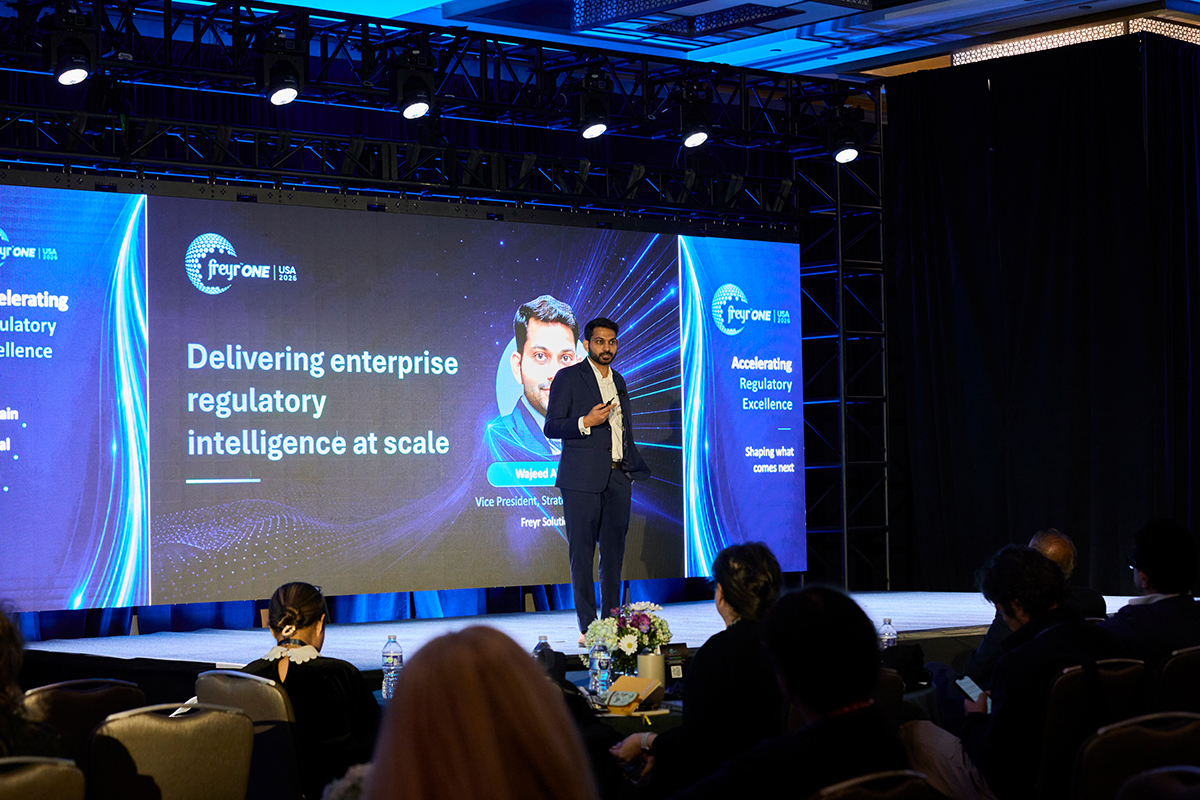
At Freyr One USA 2026, the session ‘Delivering enterprise regulatory intelligence at scale’ examined a practical question: when regulatory change affects several functions, how quickly can an organization assess its implications and coordinate a response? That depends on connecting regulatory knowledge to the company's business context and shared processes.
The discussion positioned regulatory intelligence as an enterprise capability with consequences for compliance, expert capacity and product strategy. Connecting external developments with internal business knowledge supports both a coordinated response to change and more specific operational and strategic decisions.
Enterprise intelligence begins with understanding the internal business context
A guidance may be available in a database while its significance for a product, market or function remains unclear. A small group of subject matter experts often carries responsibility for interpreting that change, assessing portfolio implications and identifying who needs to respond.
Relying on individuals to maintain a complete picture of every product, process and responsibility makes a consistent response difficult to sustain as portfolio complexity grows.
Personalization embeds the company's own context in the intelligence process. Freyr's proprietary Knowledge Manager connects industry terminology with the products, markets and assets configured for the business. Company-specific rules then help establish priority and identify the teams responsible for reviewing an update.
Personalization establishes relevance at organization, department and individual levels. Shared priorities allow each function to assess its own responsibilities within the wider business response.
Trust in AI depends on the knowledge behind the answer
The session highlighted the gap between experimenting with AI and relying on it in everyday regulatory work. Context, relevance and source verifiability were central concerns. Confidence depends on being able to establish where an answer comes from, how it relates to the business and what supports its conclusions.
Domain engineering translates regulatory expertise into classifications, terminology and relationships that AI can use. Useful metadata and expert interpretation preserve the meaning of regulations and other documents within an AI-ready repository.
Our Knowledge Graphs capture regulatory relationships and dependencies, including how a requirement in one area may affect another. A change involving product stability may also require consideration of packaging. Encoding these connections makes specialist knowledge reusable across assessments.
This is the practical connection between Domain, Digital and Data. Expertise establishes regulatory meaning, structured data makes it reusable, and digital systems apply it within assessments and workflows. Continuing curation and quality checks are essential to maintaining that foundation. Data readiness becomes an ongoing operating responsibility, with ownership extending beyond the initial implementation.
Impact assessment needs a clear path to an agreed response
Once a change is considered relevant, the organization must determine what it means in practice. A product assessment may prompt a labeling review, a revision to an internal procedure or input from another function. Those activities need a common evidence base and a defined route to resolution.
Freya.Intelligence's automated impact assessments prepare findings and recommendations for affected products, departments and processes. Personalized assessment packs give specialists a relevant starting point. They can then examine the evidence, contribute their own assessments and resolve differences with colleagues responsible for other parts of the response.
Expert judgment remains central through review and approval. The consolidated assessment must translate into specific actions, with owners and deadlines that teams can track through implementation. Shared visibility gives leaders a basis for identifying unresolved questions, delayed actions and functions that need additional support.
The efficiency opportunity extends across the handoffs between these stages. Connecting information gathering, assessment and implementation can reduce coordination effort while preserving expert oversight. Enterprise scale depends on the ability to carry a change through to an accountable response.
Specific regulatory decisions require structured and traceable reasoning
The session distinguished between broad regulatory exploration and decisions that depend on a precise set of conditions. In post-approval lifecycle management, the details of a change can alter the applicable requirements. Teams need an answer that reflects the specific scenario and explains how the relevant conditions have been applied.
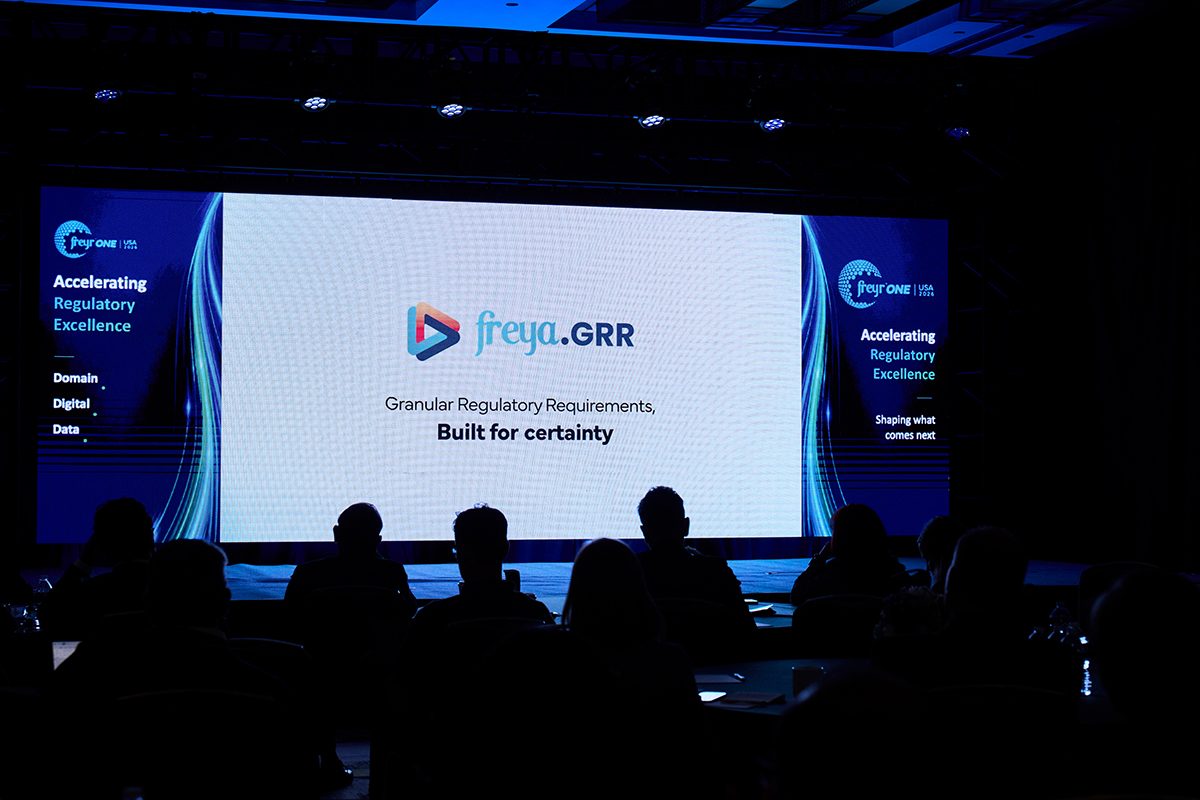
This was the role described for deterministic intelligence. Freya.GRR, or Granular Regulatory Requirements, brings expert-curated knowledge into structured repositories designed around particular business questions. Specialized agents apply conditional logic to that knowledge, using regulatory context to work through the scenario and produce an explainable recommendation.
A defined purpose establishes the scope of the agent's reasoning. It must be clear which question the agent supports, what evidence it uses and when additional information is required. Clarifying a missing input is part of reaching a defensible conclusion. Traceable reasoning gives regulatory reviewers a basis for evaluating the recommendation before deciding how to proceed.
Internal knowledge gives strategic decisions a stronger evidence base
Some of the most useful regulatory intelligence is already inside the organization. Submissions, responses to health authority questions and previous regulatory interactions contain knowledge that can inform future decisions. When that information remains scattered across files, its use depends heavily on individual experience and institutional memory.
Preparing this knowledge for AI allows the company's regulatory experience to be assessed alongside external evidence. A decision about a product's next development opportunity, for example, requires a view of internal readiness as well as clinical activity, competitors and approved indications.
Each source addresses a different aspect of the decision. A trial may indicate that a competitor is pursuing an opportunity. An approved label establishes the indication already authorized. Internal development records help determine the company's readiness to act. Evaluating these perspectives together creates a more complete basis for prioritization.
Specialized agents can work with distinct data repositories and investigate questions raised by one another's findings. An apparent gap in one source warrants further investigation before it can inform a strategic choice. The resulting recommendation should make both its supporting evidence and any unresolved questions visible to decision-makers.
Value should be assessed across the full regulatory response
The value discussion considered the effort involved in monitoring regulations, maintaining databases and coordinating compliance work, alongside the consequences of missed requirements or delayed decisions. These activities establish the baseline against which an investment should be assessed.
A credible business case needs to distinguish released expert capacity from reductions in expenditure, and both from potential market or risk benefits. Time saved in preparation may be redirected toward interpretation, review or other priorities. Potential financial benefits depend on how those changes affect the organization in practice.
For senior leaders, the assessment should connect the investment to specific improvements in the regulatory response, accounting for implementation and ongoing operating costs. The relevant question is how intelligence changes the quality, timeliness and coordination of the work and decisions it supports.
The next stage is collaboration across regulatory domains
The closing discussion considered how agents with different areas of expertise might collaborate on questions spanning pharma and medical devices. A product may have different classifications across markets, requiring several regulatory perspectives within one assessment.
The approach being explored reflects how human specialists work together. Agents drawing on separate repositories contribute their respective interpretations to a shared question, with the aim of addressing overlapping requirements. Cross-domain reasoning remains under development, and the session acknowledged the complexity still to be resolved.
This gives today's work on regulatory data a longer-term purpose. Knowledge structured for a current business question can later contribute to a more complex assessment involving other agents. Preparing today's systems for tomorrow begins with maintaining the expertise and information on which those future capabilities will depend.
See how Freya.Intelligence connects regulatory change to your products, markets and teams to support informed decisions.