Consulta


6 min di lettura
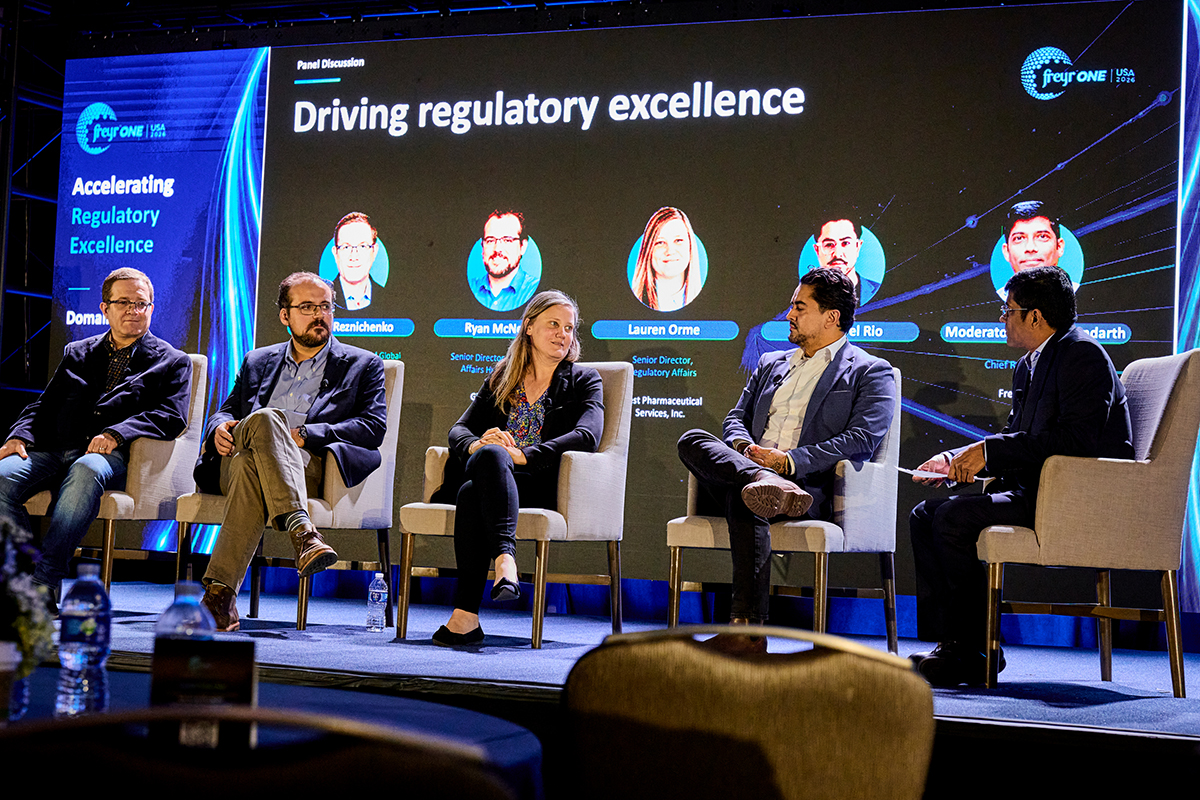
At Freyr One USA 2026, a panel of industry leaders including Boris Reznichenko (Otsuka), Ryan McNeely (Gilead Sciences), Lauren Orme (West Pharmaceutical Services), and Andres Del Rio (LIPTON Teas and Infusions) came together for a thought-provoking discussion on what it will take to drive regulatory excellence in the years ahead. Regulatory Excellence is the ability of an organization to anticipate regulatory change, make informed decisions, maintain compliance and translate regulatory expertise into better business outcomes. The conversation explored how Regulatory organizations are responding to accelerating change, increasing complexity, evolving business expectations and the rapid emergence of AI-enabled capabilities. While the discussion touched on important aspects in Regulatory Affairs, Regulatory Intelligence and automation to workforce transformation and global harmonization, a clear theme emerged: the future of Regulatory will be defined not by technology alone, but by how effectively organizations combine people, processes, data and AI to drive better decisions and business outcomes.
Regulatory complexity is increasing faster than traditional operating models can adapt
One of the strongest themes throughout the discussion was the growing complexity facing Regulatory teams. Organizations are navigating overlapping regulations, increasing global variation, evolving quality requirements, sustainability expectations, new therapeutic modalities, and rising pressure to bring products to market faster. Several panelists observed that many regulatory operating models were designed for a world where change occurred more slowly and could be addressed through downstream compliance activities. That world no longer exists.
The challenge is not simply the volume of change, but the pace at which it is arriving. Regulatory teams are being asked to deliver more, support broader business objectives, and respond more rapidly while maintaining the same standards of quality and compliance. As one panelist observed, Regulatory is in a state of "continuous advancement," creating significant opportunity but also substantial pressure on teams trying to keep pace.
The shift from reactive compliance to proactive influence has become essential
Historically, many Regulatory functions have operated as downstream reviewers, responding to changes once they had already been defined. The panel argued that this approach is becoming increasingly difficult to sustain. Regulatory excellence increasingly requires teams to identify signals earlier, anticipate change, and participate more actively in strategic decision-making.
Several examples highlighted the importance of monitoring emerging trends and engaging before regulatory change becomes formalized. Rather than waiting for new regulations to be published, proactive organizations are investing in horizon scanning, understanding where policy discussions are headed, and evaluating potential implications well in advance. This approach not only provides more time to prepare but also creates opportunities to influence industry conversations and engage with regulators earlier in the process.
The implication is significant. As Regulatory moves upstream, its value increasingly comes from helping organizations make better decisions earlier rather than simply ensuring compliance later.
AI adoption is ultimately a trust challenge
The panel agreed that AI's role is not to replace regulatory expertise but to augment it, and that AI-enabled regulatory services work best when paired with human judgement. Human judgement remains essential, particularly in environments where decisions can have patient, product, and regulatory consequences.
One observation captured the mood of the discussion well: humans make mistakes, and AI makes mistakes too. The question therefore is not whether AI is perfect, but how organizations create the right balance between automation and expert oversight. Building confidence in AI requires more than deploying tools. It demands governance, education, validation, and practical experience. Panelists emphasized the importance of starting with clearly defined problems, validating outcomes through pilots, and creating opportunities for employees to develop confidence in AI-enabled ways of working. Trust is earned through repeated success, not assumed through technology investment alone.
Information is abundant. Intelligence remains the differentiator
Another recurring theme was the distinction between information and intelligence. Regulatory organizations today have access to unprecedented amounts of data, guidance, submissions, market information, and regulatory updates. Yet access to information, by itself, no longer provides competitive advantage.
What matters is the ability to generate insight. The discussion repeatedly returned to the idea that Regulatory teams must move beyond collecting, storing, and managing information. The future lies in understanding context, identifying patterns, assessing impact, and translating information into actions and decisions. Regulatory intelligence therefore becomes not simply a technology capability but a business capability; one that enables organizations to anticipate change rather than react to it.
Transformation succeeds when people and processes evolve alongside technology
The panel argued that transformation efforts often fail for organizational rather than technical reasons. Several panelists noted that technology is rarely the primary obstacle. More often, challenges emerge from outdated processes, insufficient change management, poor data foundations, or a lack of organizational readiness.
AI, automation and intelligent systems cannot simply be layered onto existing ways of working. Organizations must also be willing to revisit long-standing business processes, redefine responsibilities, invest in new skills, and prepare teams for different ways of working. As one panelist put it, technology should not be treated as a "bolt-on" solution. Real transformation requires a willingness to rethink the foundations of how work gets done.
This is particularly important as organizations seek to scale successful pilots into enterprise-wide initiatives. Many participants agreed that adoption typically begins with focused proofs of concept. However, achieving meaningful business impact requires moving beyond isolated use cases toward a coordinated enterprise strategy.
Looking ahead: Regulatory excellence will be measured differently
If there was one message that connected every part of the discussion, it was that the definition of regulatory excellence is evolving. Success will continue to require compliance, quality and scientific rigor. Yet increasingly, Regulatory will also be measured by its ability to anticipate change, generate insight, influence decisions, improve business outcomes, and enable organizations to navigate complexity with greater speed and confidence.
The future envisioned by the panel was not one in which technology replaces expertise. Rather, it was one in which AI, automation, intelligence and human judgement work together to create more proactive, more connected and more effective regulatory organizations.
For industry leaders, the next step is clear: move beyond isolated technology discussions and begin rethinking how Regulatory creates value. The organizations that thrive will be those that combine technological innovation with organizational readiness, transforming not just the tools they use, but the way Regulatory contributes to the business as a whole.
Conclusion: The Future of Regulatory Excellence
Regulatory Excellence is no longer defined by compliance and quality alone. It increasingly depends on an organization's ability to anticipate change, generate intelligence, make informed decisions and contribute to business outcomes. Achieving this requires more than better technology. It calls for connected processes, trusted data, capable people and the ability to adapt as regulatory expectations evolve. As Regulatory takes on a more strategic role, organizations will need partners who understand both the complexity of regulatory requirements and the possibilities of digital transformation. Freyr brings together domain expertise, digital capabilities and data to help organizations navigate this evolution. The opportunity is to move beyond managing regulatory requirements and enable Regulatory to create greater business value.
Ready to move from compliance to regulatory excellence? Talk to Freyr’s regulatory intelligence experts.